Category: digital marketing

  • Digital Marketing for Entrepreneurs: A Complete Guide

    As an entrepreneur, you know that digital marketing is essential to the success of your business. But what exactly is digital marketing for entrepreneurs, and how can you use it to grow your business? In this blog, we’ll explore in-depth digital marketing and how it helps entrepreneurs to stay ahead of competitors.

    Digital Marketing: Overview

    Digital marketing refers to the practice of promoting a product, service, or brand using digital channels and technologies. It includes a wide range of tactics and strategies, such as social media marketing, search engine optimization (SEO), pay-per-click (PPC) advertising, email marketing, content marketing, and more.

    The goal of digital marketing is to connect with customers and potential customers where they spend most of their time: online. This is accomplished by creating and delivering targeted, engaging content across a variety of digital channels, such as social media platforms, search engines, email inboxes, and mobile apps.

    Why is digital marketing essential for entrepreneurs?

    Digital marketing has become an essential aspect of any entrepreneur’s success in today’s digital age. With the increasing prevalence of online communication and commerce, it has become crucial for businesses to have a strong online presence to attract and retain customers. Digital marketing provides entrepreneurs with a cost-effective way to reach their target audience, build brand awareness, and generate leads and sales. Through various digital channels such as social media, email marketing, search engines, and online advertising, entrepreneurs can engage with customers globally and provide them with a personalized experience. Digital marketing also provides real-time data and analytics, allowing entrepreneurs to measure the effectiveness of their marketing campaigns and make data-driven decisions. Overall, digital marketing is essential for entrepreneurs to remain competitive, reach a wider audience, and achieve their business goals in the digital era.

    How digital marketing helps entrepreneurs?

    Digital marketing can be a powerful tool for entrepreneurs looking to promote their businesses and reach new customers. Here are some ways that digital marketing can help entrepreneurs:

    1- Increased visibility: By utilizing digital marketing channels such as social media, search engines, email marketing, and online advertising, entrepreneurs can increase their visibility and reach a larger audience.

    2- Targeted marketing: Digital marketing allows entrepreneurs to target specific demographics, geographic locations, and interests, which can result in a more effective marketing campaign and higher conversion rates.

    3- Cost-effectiveness: Compared to traditional marketing strategies like print or television advertising, digital marketing may be more affordable. Entrepreneurs can set budgets for their digital marketing campaigns and track their ROI to ensure that they are getting a good return on investment.

    4- Build relationships with customers: Digital marketing allows entrepreneurs to engage with their customers through social media, email marketing, and other channels. This can help build relationships with customers, increase brand loyalty, and encourage repeat business.

    5-:Measure success: Digital marketing provides entrepreneurs with a wealth of data and analytics that can be used to measure the success of their campaigns. This data can be used to optimize future campaigns and improve overall business performance.

    How can you use digital marketing to expand your business?

    Here are some tips for using digital marketing to grow your business:

    1. Use search engine optimization (SEO) to get your website to the top of search engine results in pages. This will help you get more website, visitors and potential customers.
    2. Use social media to reach out to potential and current customers. Use platforms like Facebook, Twitter, and LinkedIn to connect with people, and share valuable content that will interest them.
    3. Use email marketing to stay in touch with your customers and promote your business. Send out newsletters, special offers, and other communications that will keep people engaged with your business.
    4. Use pay-per-click (PPC) advertising to get your website and products in front of potential customers. PPC ads can be a great way to generate leads and sales.
    5. Use content marketing to attract attention and build trust with potential and current customers. Share blog posts, infographics, images, and other types of content that will interest people and help them learn more about your business.

    Digital marketing is a powerful tool that every entrepreneur should use to grow their business. By following these tips, you can start to see results and reach more customers than ever before.

    Best digital marketing strategies for entrepreneurs

    As an entrepreneur, there are several digital marketing strategies you can use to promote your business and reach a wider audience. Here are some effective strategies to consider:

    1- Develop a strong online presence: Creating a professional website is crucial for your business. Ensure that the website is attractive to the view, mobile-friendly, and simple to navigate. You can also create social media profiles for your business to reach potential customers where they spend most of their time.

    2- Use search engine optimization (SEO): SEO involves optimizing your website content for search engines, such as Google, to increase your website’s visibility in search results. Research keywords that are relevant to your business and use them in your website’s content, meta descriptions, and URLs.

    3- Leverage social media: Social media can be a powerful tool to promote your business and engage with your target audience. Choose the social media platforms that your audience uses the most, and create content that is relevant and valuable to them.

    4- Invest in paid advertising: Paid advertising, such as Google Ads or social media advertising, can help you reach a wider audience and drive traffic to your website. Set a budget and target specific demographics, locations, or interests to maximize the effectiveness of your ad campaigns.

    5- Use email marketing: Email marketing allows you to communicate with your customers and keep them updated on your latest products, services, and promotions. Build an email list by offering valuable content, such as a free ebook or newsletter, and send regular emails to keep your subscribers engaged.

    6- Create valuable content: Content marketing involves creating and sharing valuable content, such as blog posts, videos, or infographics, to attract and retain a clearly defined audience. Your content needs to be informative, engaging, and relevant to the interest of your audience.

    7- Monitor and analyze your results: Use analytics tools, such as Google Analytics, to track your website traffic, social media engagement, and email open rates. Analyze your results regularly to see what works and what doesn’t, and adjust your strategy accordingly.

    Conclusion

    Digital marketing has become an essential component of entrepreneurship in today’s world. It allows entrepreneurs to reach out to their target audience cost-effectively and efficiently. It also provides them with invaluable insights into consumer behavior and preferences, enabling them to tailor their marketing strategies accordingly.

    Moreover, digital marketing is highly flexible, allowing entrepreneurs to adjust their marketing efforts in response to changing market trends and consumer preferences. They can also easily track the success of their campaigns through metrics such as website traffic, conversion rates, and social media engagement.


    Q- What does digital marketing mean?

    Ans- Digital marketing refers to the practice of promoting a product, service, or brand using digital channels and technologies.

    Q- What are the tactics used in digital marketing?

    Ans- Social media marketing, search engine optimization (SEO), pay-per-click (PPC) advertising, email marketing, content marketing, etc are some of the tactics used in digital marketing.

    Q- Is digital marketing replacing traditional marketing?

    Ans- Digital Marketing isn’t completely replacing traditional marketing but it is more effective and efficient than the traditional marketing approach.

    Q- How digital marketing helps entrepreneurs?

    Ans- Digital marketing can help entrepreneurs reach new customers, build brand awareness, and drive business growth in a cost-effective and measurable way.

    Q- Who is an entrepreneur?

    Ans- An entrepreneur is a person who starts a new business or venture and is willing to take on financial and personal risks to achieve success.

    Q- Is digital marketing relevant for entrepreneurship?

    Ans- Yes, digital marketing is highly relevant for entrepreneurship. It has become a crucial component of the overall marketing strategy for many small and large businesses today.

    Q- Does the use of digital marketing strategies help entrepreneurs start their businesses?

    Ans- Digital Marketing offers numerous tactics to entrepreneurs, with the help of which they can start and grow their businesses in a short period.
  • B2B Influencer Marketing: Strategies for Business Growth

    [vc_row][vc_column][vc_column_text css=””]In today’s digital world, B2B influencer marketing has become a smart way to grow business and build trust. Unlike B2C, where influencers promote directly to consumers, B2B influencer marketing focuses on professional relationships, industry credibility, and thought leadership.

    Whether you’re a small business or a growing enterprise, using a well-planned B2B influencer strategy can help you attract quality leads, build strong partnerships, and stay ahead of the competition.

    In influencer marketing, the spotlight has long shone on B2B collaborations. However, the transformative power of influencer marketing extends well beyond the consumer landscape. B2B influencer marketing has emerged as a potent strategy for connecting with professional audiences and building growth.

    This blog explores the world of B2B influencer marketing, exploring its unique dynamics, benefits, and effective strategies for engaging and resonating with professional audiences.


    What is B2B Influencer Marketing?

    B2B influencer marketing refers to the practice of collaborating with authoritative individuals, experts, or thought leaders within a specific industry to promote products, services, or ideas to other businesses. Unlike B2C influencer marketing, which targets consumers, B2B influencer marketing focuses on reaching professional audiences, such as decision-makers, executives, and stakeholders within other businesses.

    In B2B influencer marketing, influencers are individuals who have gained credibility and recognition within their industry due to their expertise, thought leadership, and insights. Brands partner with these influencers to leverage their reputation and reach to enhance brand credibility, build thought leadership, and establish meaningful connections with target B2B influencers.

    The goal of B2B influencer marketing is to create authentic and valuable content that resonates with the specific challenges, trends, and interests of professionals within a given industry. By collaborating with influencers who have a deep understanding of the industry, brands can tap into their expertise to create content that addresses relevant issues, provide insights, and offers solutions, ultimately fostering trust and engagement within the B2B space.

    Some examples of B2B influencers:

    • SaaS experts on LinkedIn
    • Tech bloggers
    • Industry podcast hosts
    • Marketing authors
    • Startup mentors

    Benefits of B2B Influencer Marketing

    1. Credibility and Trust: 

    Collaborating with recognized experts within a niche builds credibility for your brand, as their endorsement serves as a seal of approval in the eyes of your target audience.

    2. Thought Leadership:

    Partnering with influencers known for their insightful perspectives positions your brand as a thought leader within your industry, sparking valuable discussions and conversations.

    3. Content Enhancement: 

    Influencers bring their unique viewpoints and expertise, enriching your content with fresh insights and perspectives that resonate with professional audiences.

    4. Humanizing B2B Brands: 

    B2B influencer marketing humanizes brands by associating them with real people, fostering more personal and relatable connections.

    5. Access to Niche Audiences: 

    Influencers typically have a dedicated following within a specific industry or vertical. This allows you to tap into a well-defined audience aligned with your business goals.


    B2B Influencer Marketing


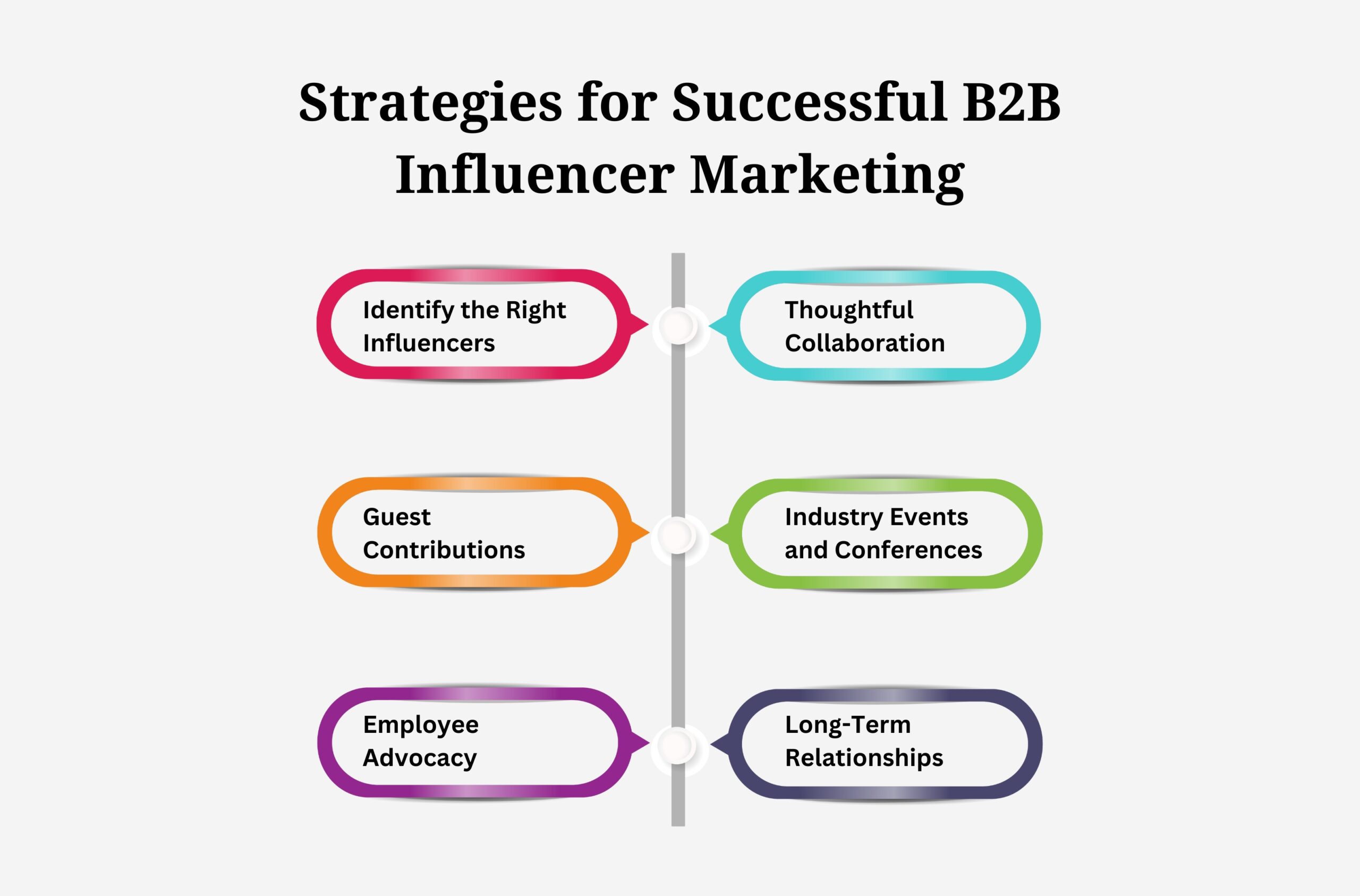
    Strategies for Successful B2B Influencer Campaigns

    1. Identify the Right Influencers: 

    Seek out influencers who are well-respected in your industry, have a strong online presence, and align with your brand’s values and objectives. Their credibility should complement your brand’s mission.

    2. Thoughtful Collaboration: 

    Collaborate with influencers on meaningful and insightful content that addresses industry challenges, trends, and solutions. This content should provide genuine value to your target audience.

    3. Educational Webinars and Workshops: 

    Host webinars or workshops in partnership with influencers to provide in-depth insights, training, and knowledge-sharing. This showcases your brand’s commitment to education and professional development.

    4. Guest Contributions: 

    Invite influencers to contribute guest blog posts, articles, or podcasts that provide unique perspectives on industry trends, fostering a collaborative exchange of insights.

    5. Industry Events and Conferences: 

    Partner with influencers to co-host or participate in industry events, panels, and conferences, showcasing your brand’s active engagement in thought leadership.

    6. Employee Advocacy: 

    Empower your employees to be influencers within their respective fields. Encourage them to share their expertise on social media and industry platforms, expanding your brand’s reach.

    7. Long-Term Relationships: 

    Cultivate long-term relationships with influencers to build trust and authenticity over time. A series of collaborations strengthen the influencer’s association with your brand.


    Case Study: B2B Influencer Marketing Example

    A leading B2B software company leverages influencer marketing to connect with professionals in the tech industry. They collaborated with industry experts and C-level executives to co-create thought-provoking whitepapers and webinars discussing emerging technology trends. By tapping into the influencers’ expertise and aligning their insights with the company’s offerings, the campaign garnered substantial engagement and positioned the brand as an authority within the tech landscape.


    Does B2B Influencer Marketing really Work?

    B2B influencer marketing can be effective, as it involves collaborating with industry experts and thought leaders to promote your products or services to their relevant audience. When executed well, it can enhance credibility, reach, and engagement within the B2B space. However, success depends on proper targeting, authenticity, and aligning influencer content with your brand’s values and goals.


    Conclusion

    B2B influencer marketing represents a strategic approach to nurturing relationships, fostering thought leadership, and building credibility within professional networks. By harnessing the influence and authority of industry experts, brands can engage in meaningful conversations, contribute valuable insights, and position themselves as trusted partners. 

    As the B2B landscape continues to evolve, influencer marketing emerges as a pivotal strategy to unlock new avenues for growth, authenticity, and engagement with the professional audiences that drive industries forward.


    Frequently Asked Questions (FAQs)

    [/vc_column_text][vc_toggle title=”How do I find the right B2B influencers?” css=””]Identifying the right influencers involves research within your industry. Look for individuals with expertise, a strong online presence, and a following that aligns with your target audience.[/vc_toggle][vc_toggle title=”How do I approach B2B influencers for collaboration?” css=””]Reach out with a personalized pitch that outlines the benefits of working together. Be clear about your goals, expectations, and how the collaboration can be mutually beneficial.[/vc_toggle][vc_toggle title=”How can I measure the ROI of my B2B influencer campaign?” css=””]Calculate ROI by comparing the cost of the campaign to the revenue generated through leads or conversions. Track the impact on brand awareness and long-term customer relationships.[/vc_toggle][vc_toggle title=”What are some successful examples of B2B influencer marketing campaigns?” css=””]Research case studies in your industry to find examples of effective B2B influencer marketing campaigns. Analyze their strategies and tactics to gain insights for your own efforts.[/vc_toggle][vc_toggle title=”What are the benefits of B2B influencer marketing?” css=””]Benefits include increased brand awareness, lead generation, thought leadership, and enhanced credibility within your industry. It can also foster long-term relationships with influencers.[/vc_toggle][/vc_column][/vc_row]

  • The Future of Content Consumption: Predictive Personalization

    [vc_row][vc_column][vc_column_text css=””]In digital content, the key to capturing and retaining audiences lies in “predictive personalization“. As technology advances and data analytics become more sophisticated, content consumption is undergoing a transformational shift toward predictive personalization. This paradigm shift is poised to revolutionize how individuals interact with content as it goes beyond mere customization to anticipate user preferences and needs.


    The Evolution of Predictive Personalization

    Personalized content has been a buzzword for some time, but it has traditionally relied on user-provided data and behavior patterns. With predictive personalization, a new era emerges – one where artificial intelligence and machine learning algorithms analyze vast amounts of data to anticipate user behavior before it happens. This anticipatory approach goes beyond reacting to user actions; it proactively tailors content to suit users’ tastes, interests, and even emotions.


    Understanding Predictive Personalization

    At the core of predictive personalization is data – big data, to be precise. By collecting, analyzing, and interpreting a user’s historical interactions with content, predictive algorithms can forecast what a user is likely to engage with in the future. This is achieved through a combination of machine learning techniques, including collaborative filtering, natural language processing, and sentiment analysis. The result is a highly curated content experience that caters to individual preferences.


    Anticipating User Needs

    One of the most fascinating aspects of predictive personalization is its ability to anticipate user needs. Imagine opening your favorite news app, and before you even search for a topic, relevant articles are already displayed based on your interests. Similarly, streaming platforms could queue up TV shows and movies aligned with your mood or past viewing habits. This anticipatory approach not only enhances user experience but also saves time and eliminates decision fatigue.


    Hyper-Relevant Recommendations

    Predictive personalization enables content creators to craft hyper-relevant recommendations that resonate with users on a deeper level. Brands can align their messaging with a user’s preferences, ensuring that the content is not only timely but also tailored to the user’s individual context. This level of relevance fosters a stronger connection between users and the content, leading to increased engagement and loyalty.


    Challenges and Considerations

    While the promise of predictive personalization is exciting, it comes with its own set of challenges and considerations. Privacy concerns remain at the forefront, as predictive algorithms rely heavily on user data. Striking the delicate balance between personalization and privacy is crucial to prevent overstepping ethical boundaries.

    Additionally, the potential for creating echo chambers – where users are only exposed to content that reinforces their existing beliefs – is a concern that must be addressed.


    The Role of AI and Machine Learning

    At the heart of predictive personalization lies artificial intelligence (AI) and machine learning (ML). These technologies power the algorithms that analyze data patterns, predict user behavior, and offer tailored recommendations. As AI and ML continue to evolve, their applications in predictive personalization will become even more refined, enhancing the accuracy of content predictions and ensuring a seamless user experience.


    Personalization in Various Industries

    Predictive personalization isn’t limited to a signal industry – it has the potential to transform various sectors. In e-commerce, for instance, online retailers can provide personalized product recommendations that align with a shopper’s preferences and browsing history.

    In education, learning platforms can predict which topics a student may struggle with and offer targeted resources in advance. Even healthcare could benefit, with predictive algorithms helping doctors anticipate patient needs and recommend treatments.


    The Future of Content Consumption

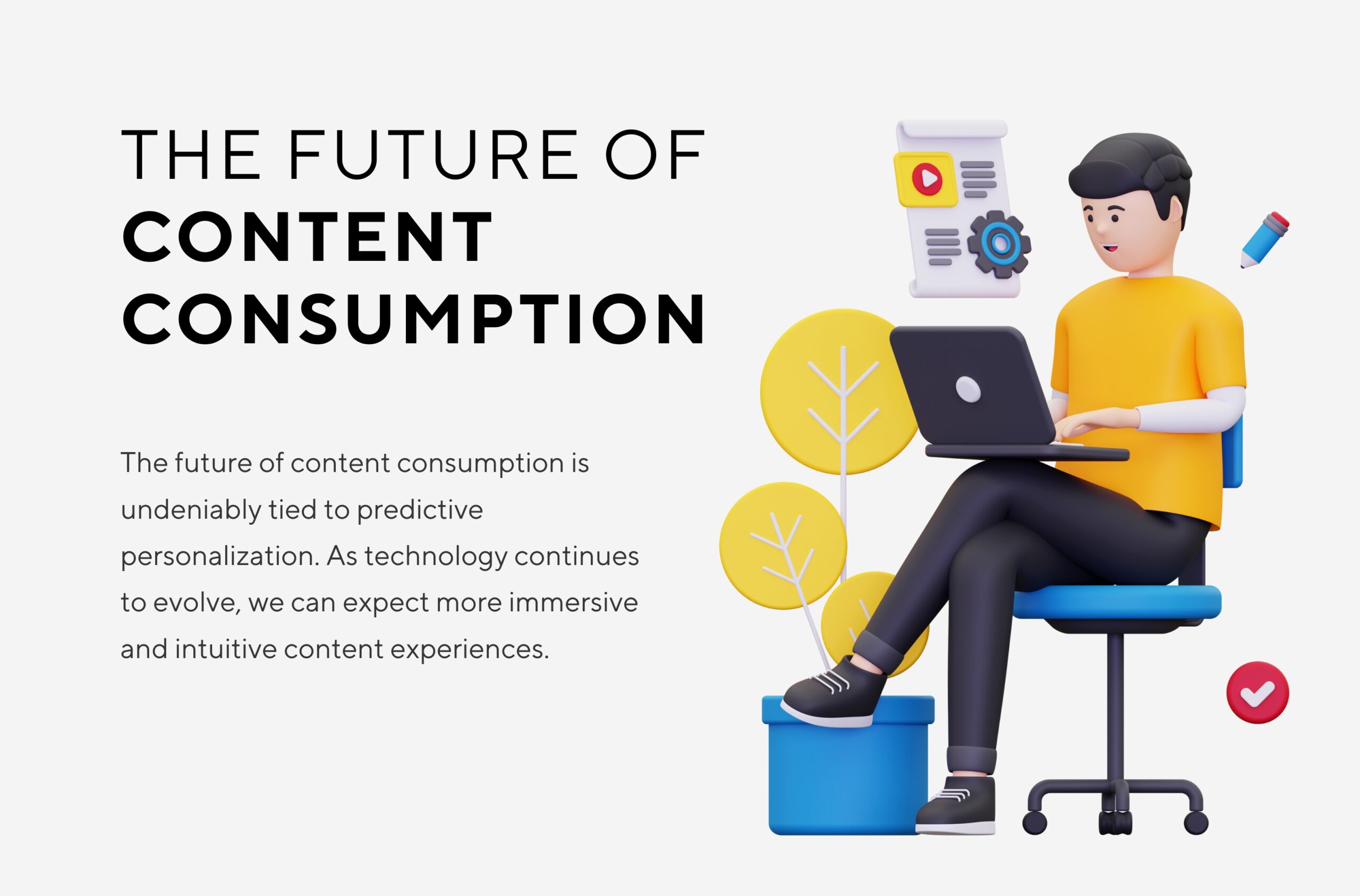
    The future of content consumption is undeniably tied to predictive personalization. As technology continues to evolve, we can expect more immersive and intuitive content experiences. However, this transformation will require a collective effort from content creators, technology developers, and policymakers to address challenges related to privacy, bias, and user autonomy. By navigating these challenges responsibly, the potential for predictive personalization to reshape content consumption is immense.


    Predictive Personalization

    Conclusion

    Predictive personalization represents a shift from reactive customization to proactive content curation. Through the power of AI and machine learning, content consumption is poised to become a more immersive, relevant, and engaging experience. 

    While challenges remain, the benefits of anticipatory content delivery are too significant to ignore. As we step into the future, content creators and consumers alike have the opportunity to embrace this new era and shape the landscape of predictive personalization for the better.


    Frequently Asked Questions (FAQs)

    [/vc_column_text][/vc_column][/vc_row][vc_row][vc_column][vc_toggle title=”What is content consumption?” css=””]Content consumption refers to the act of consuming or engaging with various types of digital or multimedia content, such as articles, videos, music, podcasts, and more, through various digital devices and platforms.[/vc_toggle][vc_toggle title=”What is personalized content consumption?” css=””]Personalized content consumption involves tailoring content recommendations and experiences to an individual’s preferences and behavior. This is often done using algorithms and AI to provide content that is most relevant to a specific user.[/vc_toggle][vc_toggle title=”How can I consume content responsibly?” css=””]Responsible content consumption involves being mindful of data usage, supporting sustainable practices, and being critical of the information you consume. It’s also important to respect copyright and intellectual property rights when engaging with digital content.[/vc_toggle][vc_toggle title=”What is the future of content consumption?” css=””]The future of content consumption includes trends like AI-driven personalization, AR and VR integration, interactive content, blockchain-based ownership, sustainability efforts, and globalized content experiences.[/vc_toggle][vc_toggle title=”How can I ensure responsible content consumption?” css=””]Responsible content consumption involves being mindful of the content you engage with. This includes fact-checking information, avoiding excessive screen time, and supporting ethical content creators. Additionally, consider the environmental impact of data consumption and strive for sustainable practices.[/vc_toggle][/vc_column][/vc_row]

  • The Psychology Behind Personalized Content: Why it Resonate With Audiences?

    In the era of information overload, capturing the attention of audiences has become an intricate art. Content creators are constantly seeking ways to connect with their target audience on a deeper level. Enter personalized content – an approach that goes beyond one-size-fits-all messaging. The allure of personalized content lies in its ability to tap into human psychology, creating a powerful resonance with individuals.

    This article explores the psychology behind personalized content and uncovers why it has become a cornerstone of effective communication in the digital age.


    Understanding Personalization

    Personalized content is about tailoring messages, recommendations, and experiences to suit the unique preferences and needs of individual consumers. Thanks to advances in technology and data analytics, brands now have the tools to curate content that speaks directly to each person, increasing engagement, brand loyalty, and ultimately, conversion rates.


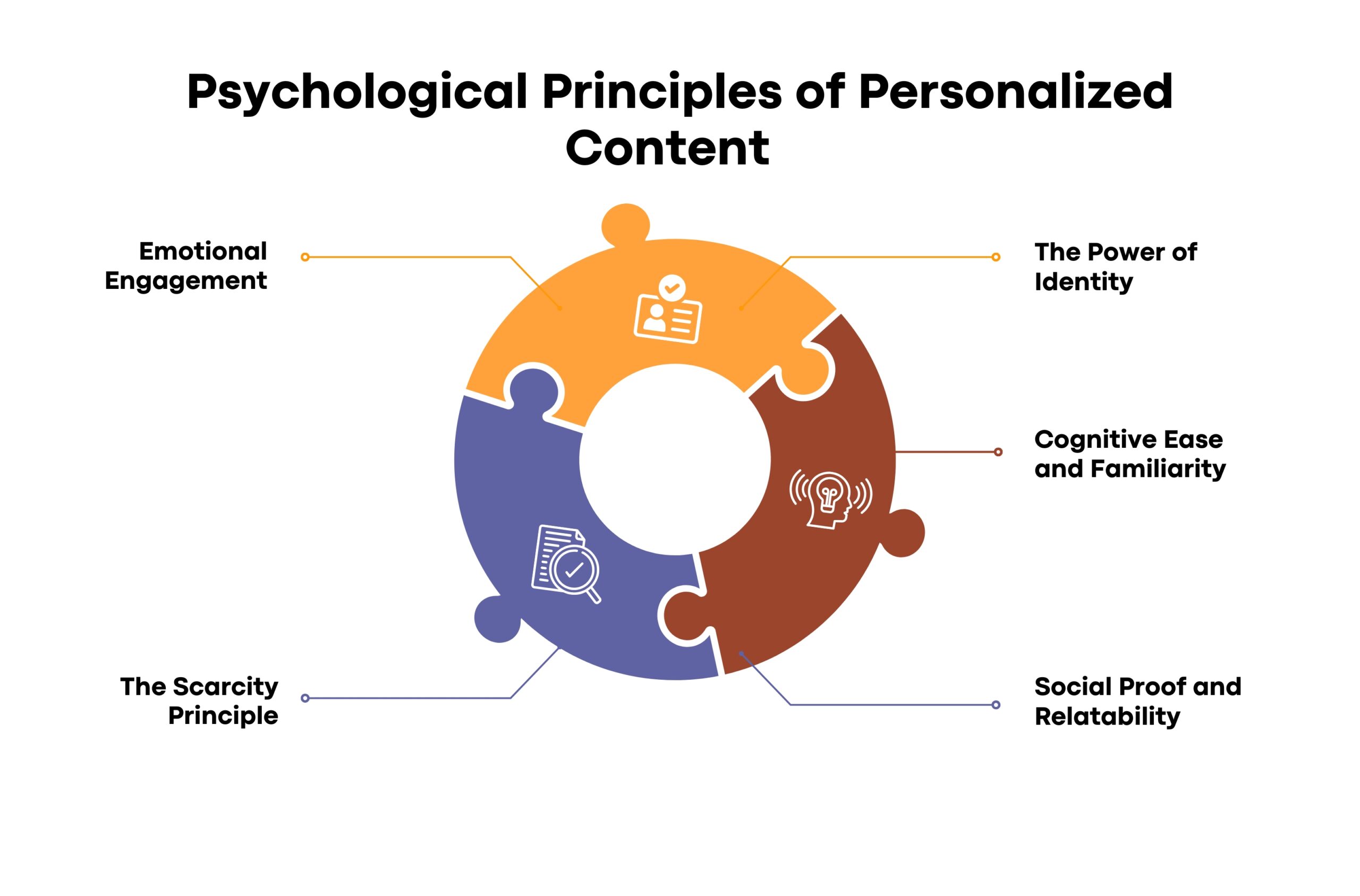
    Psychological Principles of Personalized Content


     Personalized Content1. The Power of Identity: 

    One of the primary reasons personalized content resonates with audiences is its ability to reinforce a person’s sense of identity. When individuals encounter content that aligns with their values, beliefs, and interests, they feel validated and understood. This alignment reinforces their identity and fosters a stronger connection with the brand.

    2. Cognitive Ease and Familiarity: 

    Personalized content feels familiar and relevant. This taps into the cognitive ease principles – our brains are naturally drawn to information that is easy to process. When content feels familiar due to personalization, audiences are more likely to engage with it.

    3. Social Proof and Relatability: 

    Human beings are inherently social creatures, and we often take cues from the behavior of others. Personalized content that showcases how others with similar profiles or preferences have engaged with a product or service provides social proof, making the content more relatable and credible.

    4. Emotional Engagement: 

    Personalized content has the ability to evoke emotions in audiences. Whether it’s nostalgia, joy, empathy, or excitement, content that speaks directly to an individual’s experiences triggers emotional responses. These emotions create a memorable connection with the brand.

    5. The Scarcity Principle: 

    When content is personalized, it creates a perception of scarcity. Audiences feel that the content is tailored specifically for them, which can trigger a sense of exclusivity and increase the perceived value of the message.


    Personalization Technique and Strategies

    1. Behavioral Data Analysis: 

    Brands use behavioral data such as browsing history, purchase behavior, and interaction patterns to predict what content a user might be interested in. This approach taps into the principle of familiarity and offers content that aligns with a user’s past behaviors.

    2. Segmentation and Audience Profiling: 

    Segmentation involves dividing an audience into smaller groups based on shared characteristics. Brands then create content that speaks to the unique needs and preferences of each segment, increasing the sense of identity and relatability.

    3. Dynamic Content Creation: 

    Dynamic content involves tailoring specific elements of a message to match the recipient’s profile. This could range from using their name in an email subject to showcasing products that match their previous purchases.

    4. Predictive Analytics: 

    Leveraging machine learning and predictive analytics, brands can anticipate user preferences before they even express them. This anticipatory approach taps into the psychology of surprise and delight.


    Benefits of Personalized Content

    1. Enhanced Engagement: 

    Personalized content drives higher engagement rates compared to generic content. When audiences feel that content speaks directly to them, they are more likely to interact, share, and comment.

    2. Increase Conversion Rates: 

    A personalized experience guides users through the buyer’s journey more effectively. Whether it’s tailored product recommendations or personalized email campaigns, content that aligns with user preferences increases the likelihood of conversions.

    3. Customer Loyalty and Advocacy: 

    When individuals feel understood and valued by a brand, they are more likely to become loyal customers and brand advocates. This word-of-mouth promotion can have a lasting impact on a brand’s reputation.

    4. Reduced Decision Fatigue: 

    The abundance of choices in the digital world can lead to decision fatigue. Personalized content streamlines choices, making it easier for audiences to make decisions that align with their preferences.


    Ethical Considerations

    While personalized content has its benefits, ethical considerations must not be overlooked. The collection and use of user data raise concerns about privacy and consent. Brands must be transparent about data usage and give users the ability to opt out of personalization. Additionally, the potential for algorithmic bias in content recommendations must be addressed to ensure fairness and inclusivity. 


    Conclusion

    The psychology behind personalized content is rooted in fundamental principles of human behavior and cognition. By aligning content with individual identities, preferences, and emotions, brands can create a deep resonance that goes beyond mere marketing. However, the responsible use of data and a keen awareness of ethical considerations are paramount as the world of personalized content continues to evolve. As technology advances and our understanding of psychology deepens, the possibilities for crafting content that truly speaks to each individual’s soul are boundless.

  • Personalization vs. Privacy: How to Find the Right Balance

    Today, “personalization vs. privacy” have become two of the most critical and frequently debated aspects of our online lives. On the one hand, personalization offers tailored experiences, making our interactions with technology more convenient and enjoyable. On the other hand, privacy concerns loom large as we grapple with the collection and utilization of our personal data.

    As brands seek to deliver more relevant content, individuals become increasingly aware of the data they share and the implications for their privacy. This article delves into the intricate dance between personalization and privacy, highlighting the need to find a delicate balance that respects both user expectations and data protection.


    The Power of Personalization vs. Privacy

    Content personalization involves the use of data to create tailored experiences for users. From personalized product recommendations to targeted email campaigns, brands leverage user behavior, preferences, and demographics to curate content that resonates with each individual. This approach isn’t just a marketing trend; it’s a strategic move to break through the noise of information overload and establish genuine connections with audiences.


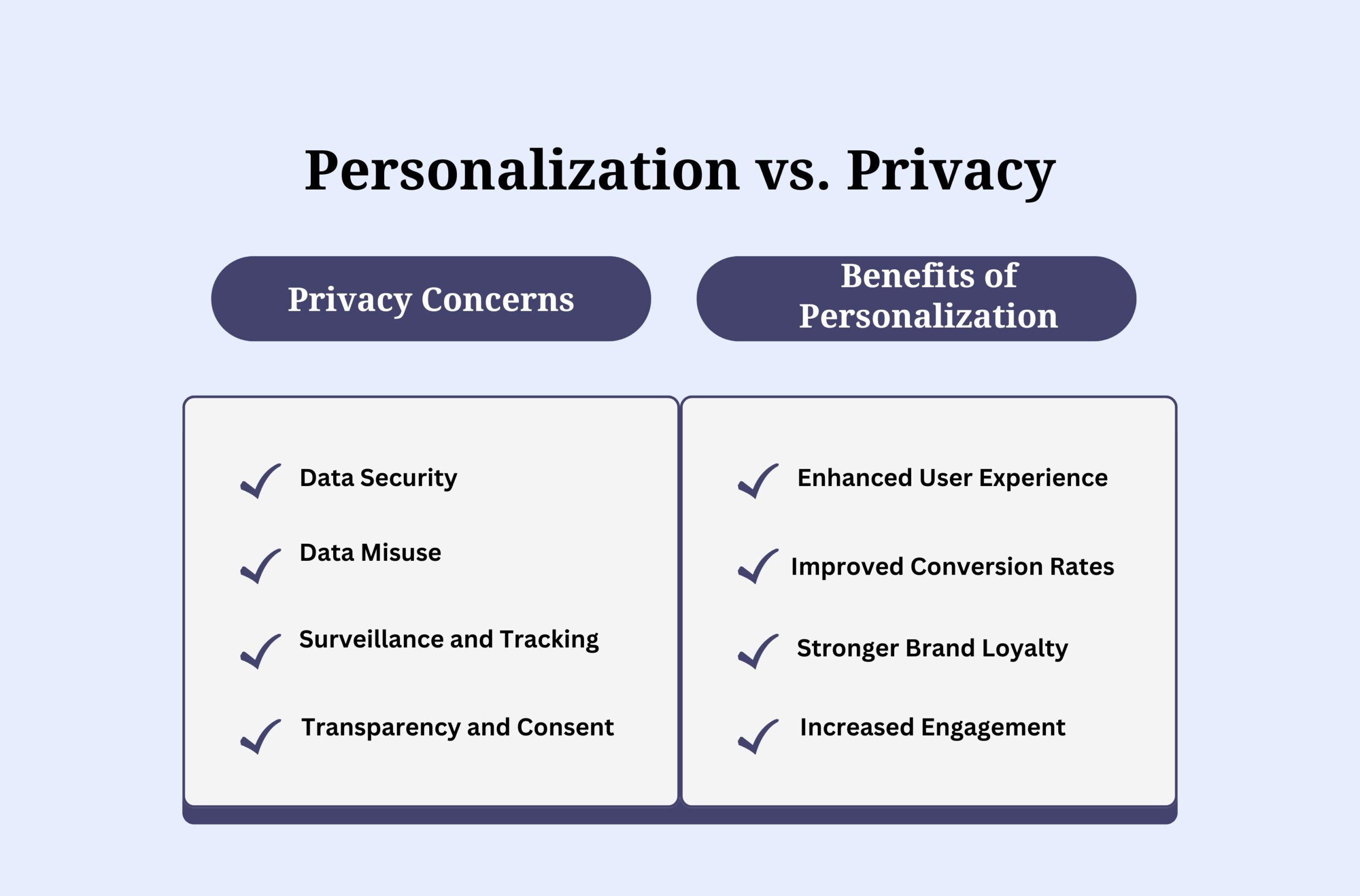
    Benefits of Personalization

    1. Enhanced User Experience: 

    Personalized content streamlines the user experience by presenting information that’s relevant and timely. This reduces decision fatigue and increases the likelihood of engagement.

    2. Improved Conversion Rates: 

    Customized content guides users through the buyer’s journey, providing them with the information they need at each stage. This results in higher conversion rates and more qualified leads.

    3. Stronger Brand Loyalty: 

    When users feel understood and valued by a brand, they are more likely to develop a sense of loyalty. Personalized experiences foster a deeper emotional connection with the brand.

    4. Increased Engagement: 

    Content that speaks directly to users’ interests and needs captures their attention and encourages them to interact, comment, and share.


    Personalization vs. Privacy


    The Privacy Issues

    As brands strive to create personalized experiences, they rely on collecting and analyzing user data. This data can range from browsing history and purchase behavior to location and demographic information. While these insights are essential for effective personalization, they raise valid concerns about user privacy, data security, and the potential for misuse.


    Privacy Concerns

    1. Data Security: 

    The more data brands collect, the higher the risk of data breaches. Unauthorized access to personal information can have severe consequences for individuals and erode trust in brands.

    2. Data Misuse: 

    Personal data collected for content customization purposes could potentially be used for unintended purposes, such as targeted advertising without consent or even identity theft.

    3. Surveillance and Tracking: 

    Users are becoming increasingly aware of being tracked online, leading to concerns about surveillance, especially when data is shared across multiple platforms.

    4. Transparency and Consent: 

    Many users are unaware of how their data is being used. Lack of transparency and the absence of clear consent processes contribute to a sense of unease.


    Striking the Balance

    As the tension between personalization and privacy continues to mount, finding a balance that respects both user preferences and data protection is crucial. Here are several strategies to achieve this equilibrium:

    1. Transparency: Brands must be transparent about the data they collect, how it’s used, and the benefits users receive from sharing their information. Clear and concise privacy policies and terms of use go a long way in building trust.
    1. User Control: Empower users by giving them control over their data. Providing opt-in and opt-out options for personalized content and data sharing ensures users have a say in the experience.
    1. Anonymization: Whenever possible aggregate and anonymize data to protect individual identities while still enabling effective personalization. This minimizes the risk of data misuse.
    1. Minimal Data Collection: Brands should only collect data that is necessary for delivering personalized experiences. Avoid unnecessary data collection to reduce the potential for data breaches.
    1. Consent Processes: Implement clear and accessible consent processes that inform users about how their data will be used. Consent should be informed, specific, and revocable.
    1. Data Security Measures: Prioritize robust data security measures to prevent unauthorized access and data breaches. Regular security audits and compliance with data protection regulations are essential.
    1. Algorithmic Fairness: Pay attention to algorithmic bias and ensure that personalized content doesn’t perpetuate stereotypes or discriminate against certain groups.
    1. Education and Empowerment: Educate users about the benefits of personalization and the steps taken to protect their privacy. When users understand the value and safeguards in place, they are more likely to engage willingly.


    Conclusion

    The tug-of-war between personalization and privacy is a complex challenge that requires thoughtful consideration from brands, policymakers, and individuals alike. Personalization offers numerous benefits in terms of engagement, loyalty, and conversion rates, but it must be approached responsibly.

    Finding the balance involves respecting user privacy, giving individuals control over their data, and employing secure practices to safeguard sensitive information. As technology evolves and the conversation around data ethics intensifies, the delicate equilibrium between personalization and privacy will continue to shape the future of digital content customization.


    Frequently Asked Questions (FAQs)

    1. How does personalization benefit users?

    Personalization enhances user experiences by offering content and recommendations that align with individual tastes and preferences. It saves time, increases engagement, and can lead to improved efficiency.


    1. What is privacy in the digital age?

    Privacy, in the digital age, concerns the protection of personal information and the ability to control how that information is collected, used, and shared. It involves safeguarding one’s data from unauthorized access or use.


    1. What steps can individuals take to protect their online privacy?

    Individuals can protect their online privacy by using strong, unique passwords, enabling two-factor authentication, regularly reviewing app permissions, and being cautious about sharing personal information online.


    1. Are there privacy regulations in place to protect user data?

    Yes, many countries have implemented data protection regulations, such as the GDPR (General Data Protection Regulation) and the CCPA (California Consumer Privacy Act, to protect user data and privacy rights.


    1. How companies ensure transparency in data practices?

    Companies can ensure transparency by providing clear and concise information about their data collection and usage practices in their privacy policies. They should also make it easy for users to access and understand this information.

  • Search Algorithms in Social Networks: Friend Suggestion and Content Discovery

    In the digital age, Search Algorithms in “social networks” have revolutionized the way we connect, share, and discover content. From reconnecting with old friends to staying updated with the latest trends, social media platforms have become an integral part of our daily lives. One of the key features that underpin the success of these platforms is their ability to suggest friends and relevant content to users.


    Friend Suggestion on Social Networks

    The days of manually searching for friends on social media are long gone, thanks to sophisticated friend suggestion algorithms. These algorithms analyze an excess of data points, including mutual friends, interests, location, and interactions, to identify potential connections. Machine learning techniques play a vital role in understanding user behavior and preferences, allowing platforms to recommend friends with a high likelihood of acceptance.

    At the heart of friend suggestion algorithms lies the concept of a social graph. Each user is a node, and their connections are represented as edges. By traversing this graph, search algorithms can uncover hidden relationships and suggest friends that users might have overlooked. This process goes beyond serendipity, as algorithms leverage the power of data to bring people together in a digital space.


    Content Discovery: From Noise to Relevance

    Inundate with a constant stream of updates, posts, and media, users often find it challenging to discover content that truly resonates with them. This is where content discovery algorithms aim to cut through the noise and present users with content that aligns with their interests, preferences, and browsing habits.

    Similar to friend suggestion algorithms, content discovery algorithms utilize machine learning to understand user behavior. By analyzing past interactions, clicks, likes, and shares, these algorithms create a user profile that captures individuals’ tastes. Using this profile, search algorithms can then recommend articles, videos, and posts that are likely to captivate the user’s attention.


    Collaborative Filtering: The Engine of Personalization

    Collaborative Filtering is a cornerstone of both friend suggestion and content discovery algorithms. This technique builds on the idea that users who have similar interests and behaviors are likely to appreciate the same content or connect. There are two main approaches to collaborative filtering: user-based and item-based.

    In user-based collaborative filtering, the algorithm identifies users with similar preferences and suggests content or friends based on what those similar users have engaged with. On the other hand, item-based collaborative filtering recommends content or friends that are similar to what users have already shown an affinity for. These techniques work in tandem to create a personalized experience that keeps users engaged and satisfied.


    Balancing Act: Privacy and Ethics in Social Networks

    While search algorithms in social networks offer numerous benefits, they also raise concerns about privacy and ethics. As algorithms analyze users’ interactions, preferences, and connections, there’s a potential for sensitive data to be mishandled or exploited. Social platforms must strike a delicate balance between offering personalized experiences and safeguarding user privacy.

    Moreover, algorithmic bias is another ethical consideration. If algorithms are not trained on diverse datasets, they might inadvertently favor certain groups or content, leading to a lack of inclusivity. Ensuring fairness and transparency in algorithm design is crucial to prevent reinforcing existing biases and creating information bubbles.


    Future Directions: From AI to Human-Centricity

    The future of search algorithms in social networks is exciting and multifaceted. Artificial intelligence (AI) and Machine learning will continue to evolve, enhancing the accuracy of friend suggestions and content recommendations. However, the focus is shifting toward creating more human-centric experiences.

    Understanding the nuances of human relationships and emotions is a challenge for algorithms, but advancements in sentiment analysis and natural language processing are making headway. Platforms are exploring ways to factor in an emotional context, enhancing the authenticity and meaningfulness of friend suggestions and content recommendations.

    Social Networks

    Conclusion Of Social Networks

    Search algorithms have transformed the landscape of social networks, elevating the way we connect, interact, and discover content. Friend suggestion and content discovery algorithms have evolved from simple rule-based systems to complex machine-learning models, offering personalized experiences to users. 

    As the digital world continues changing, the challenge lies in striking a balance between technological advancement, privacy protection, and ethical considerations. The future holds the promise of even more human-centric algorithms that enhance our social interactions and deepen our connections in the virtual realm.


    Frequently Asked Questions (FAQs)

    1. What factors influence the ranking of search results in social networks?

    Several factors influence the ranking of search results in social networks, including the relevance of keywords, the user’s past interactions, the popularity of content, and the recency posts.


    1. Can social network search algorithms personalize search results for users?

    Yes, many social network search algorithms incorporate personalization to tailor search results based on a user’s interests, connections, and previous activity on the platform.


    1. Do social networks use machine learning in their search algorithms?

    Yes, many social networks employ machine learning techniques to improve the performance of their search algorithms. Machine learning helps refine search results and adapt to user behavior over time.


    1. How do social networks handle controversial or sensitive content in search results?

    Social networks implement content moderation policies and algorithms to detect and filter out controversial or sensitive content from search results, aiming to provide a safe and positive user experience.


    1. Are there any best practices for optimizing content for social network search algorithms?

    Yes, best practices include using relevant keywords, creating high-quality content, engaging with your audience, and staying up-to-date with platform-specific guidelines and changes.

  • E-commerce Payment Gateways: What You Need To Know?

    E-commerce has transformed the way we shop, enabling us to make purchases from the comfort of our homes. However, behind the scenes of every online transaction lies a crucial element – the e-commerce payment gateway. As consumers flock to online platforms to purchase products and services, the importance of secure and seamless payment solutions cannot be overstated.

    E-commerce payment gateways” have taken center stage, facilitating transactions and ensuring a smooth shopping experience. In this blog, we will discuss the e-commerce payment gateways, exploring their significance, functionality, and key considerations.


    Understanding E-commerce Payment Gateways

    At its core, an e-commerce payment gateway is a technology that acts as an intermediary between an online store and a payment processor. Its primary role is to securely authorize and process payment transactions, facilitating the transfer of funds from customers to merchants. Payment gateways enable customers to enter their payment information during the checkout process and then securely transmit the data to the payment processor, which subsequently completes the transaction.


    Importance of Secure Transactions

    Security is a paramount concern in E-commerce, given the sensitive nature of payment information. E-commerce payment gateways employ encryption protocols to safeguard customer data, including credit card numbers, personal details, and transaction histories. The encryption ensures that information transmitted between the customer, the merchant, and the payment processor is protected from unauthorized access and potential cyber threats.


    Functionality and Transaction Flow

    The process of a payment gateway involves several steps to ensure the accuracy and security of each transaction:

    1. Customer Initiatives Payment: The customer selects products or services and proceeds to the checkout page.
    1. Data Encryption: Payment information, including credit card details, is encrypted to prevent interception by malicious actors.
    1. Payment Gateway Interaction: The encrypted data is sent to the payment gateway.
    1. Authorization: The payment gateway verifies the payment details with the customer’s bank or credit card issuer to ensure there are sufficient funds and that the transaction is legitimate.
    1. Transaction Processing: If the payment is approved, the transaction is processed, and funds are transferred from the customer’s account to the merchant’s account.
    1. Confirmation: Both the customer and the merchant receive confirmation of the successful transaction.
    1. Settlement: The funds are settled into the merchant’s account, typically within a predetermined time frame.


    Types of E-commerce Payment Gateways


    E-commerce payment gateways

    There are various types of payment gateways, each catering to different needs and preferences:

    1. Hosted Payment Gateways:

    Customers are redirected to a separate payment page hosted by the payment gateway provider. The advantage is that the merchant doesn’t handle sensitive payment data directly.

    2. Self-Hosted Payment Gateways:

    These gateways are integrated into the merchant’s website, offering a seamless user experience. Payment information is collected on the merchant’s site and then securely transmitted to the gateway.

    3. API (Application Programming Interface) Payment Gateways: 

    These gateways provide more customization options and are often used by larger E-commerce businesses. They allow for deeper integration with the website’s design and functionality.

    4. Local Payment Gateways:

    Some regions have their own preferred payment methods and gateways. Merchants need to offer options that cater to the preferences of their target audience.


    Key Considerations When Choosing a Payment Gateway

    Selecting the right payment gateway is a critical decision for any e-commerce business. Here are some key considerations:

    1. Security: Opt for a payment gateway that employs robust security measures, including encryption, PCI DSS compliance, and fraud detection.
    1. User Experience: The payment process should be user-friendly and seamless, reducing the risk of abandoned carts due to a complex checkout process.
    1. Accepted Payment Methods: Ensure that the payment gateway supports a wide range of payment methods, including credit cards, debit cards, digital wallets, and even alternative payment methods based on your target market.
    1. Integration: Check whether the payment gateway integrates smoothly with your e-commerce platform or website. Compatibility and ease of integration are crucial.
    1. Fees and Costs: Different payment gateways have varying fee structures, including transaction fees, monthly fees, and setup fees. Understand these costs before making a decision.
    1. Global Reach: If you’re catering to an international audience, consider a payment gateway that supports multiple currencies and languages.
    1. Customer Support: Reliable customer support is essential for troubleshooting issues and addressing concerns promptly.


    Prominent E-commerce Payment Gateways

    Several e-commerce payment gateways have gained prominence in the industry:

    1. PayPal: Widely recognized and accepted, PayPal offers a range of services, including direct payment processing, invoicing, and integration with various e-commerce platforms.
    1. Stripe: Known for its developer-friendly approach, Stripe provides customizable payment solutions and supports a wide array of payment methods.
    1. Square: Initially known for its point-of-sale solutions, Square has expanded into online payments, offering an integrated system for both offline and online transactions.
    1. Authorize.Net: A popular choice for businesses of all sizes, Authorize.Net offers a range of features including fraud prevention tools and recurring billing options.


    Future Trends in E-commerce Payment Gateways

    As technology continues to evolve, e-commerce payment gateways are also undergoing innovations:

    1. Mobile Payments: With the rise of mobile commerce, payment gateways are adapting to facilitate seamless mobile transactions.
    1. Biometric Authentication: Expect to see more biometric authentication methods, such as fingerprint and facial recognition, enhancing payment security.
    1. Blockchain Technology: Blockchain’s decentralized nature could potentially transform payment gateways, offering enhanced security and transparency.
    1. Integration of AI: Artificial Intelligence can play a role in fraud prevention and customer support, streamlining the payment process.


    Conclusion

    E-commerce payment gateways serve as the backbone of online transactions, ensuring secure, efficient, and seamless payment processing. Their significance cannot be understated, as they play a pivotal role in driving customer trust and satisfaction. As businesses continue to tap into the vast opportunities of the digital realm, selecting the right payment gateway becomes a strategic decision that can shape the success of an E-commerce venture. 

    By understanding the functionality, security measures, and considerations involved in choosing a payment gateway, businesses can navigate the world of online transactions with confidence and provide customers with a frictionless shopping experience.

  • Niche vs. General E-commerce: Which Approach is Right for You?

    In e-commerce, entrepreneurs faced a vital decision: whether to carve out a specialized niche or cast a wider net with a general and Niche E-commerce approach. Both strategies have their merits and challenges, and choosing the right path requires careful consideration of factors such as market trends, competition, and personal strengths. 

    In this blog, we will discuss the nuances of niche and general e-commerce, and help you determine which approach aligns with your business goals and strengths.


    Understanding Niche E-commerce

    Niche e-commerce refers to online retail businesses that cater to a specific, often specialized, segment of the market. Instead of selling a wide range of products, niche e-commerce stores focus on a particular product category, industry, or target audience. The goal is to serve a smaller, more defined customer base with unique products or services. Niche e-commerce involves targeting a specific segment of the market with unique products or services. By catering to a specialized audience, niche businesses aim to stand out in a crowded marketplace. 


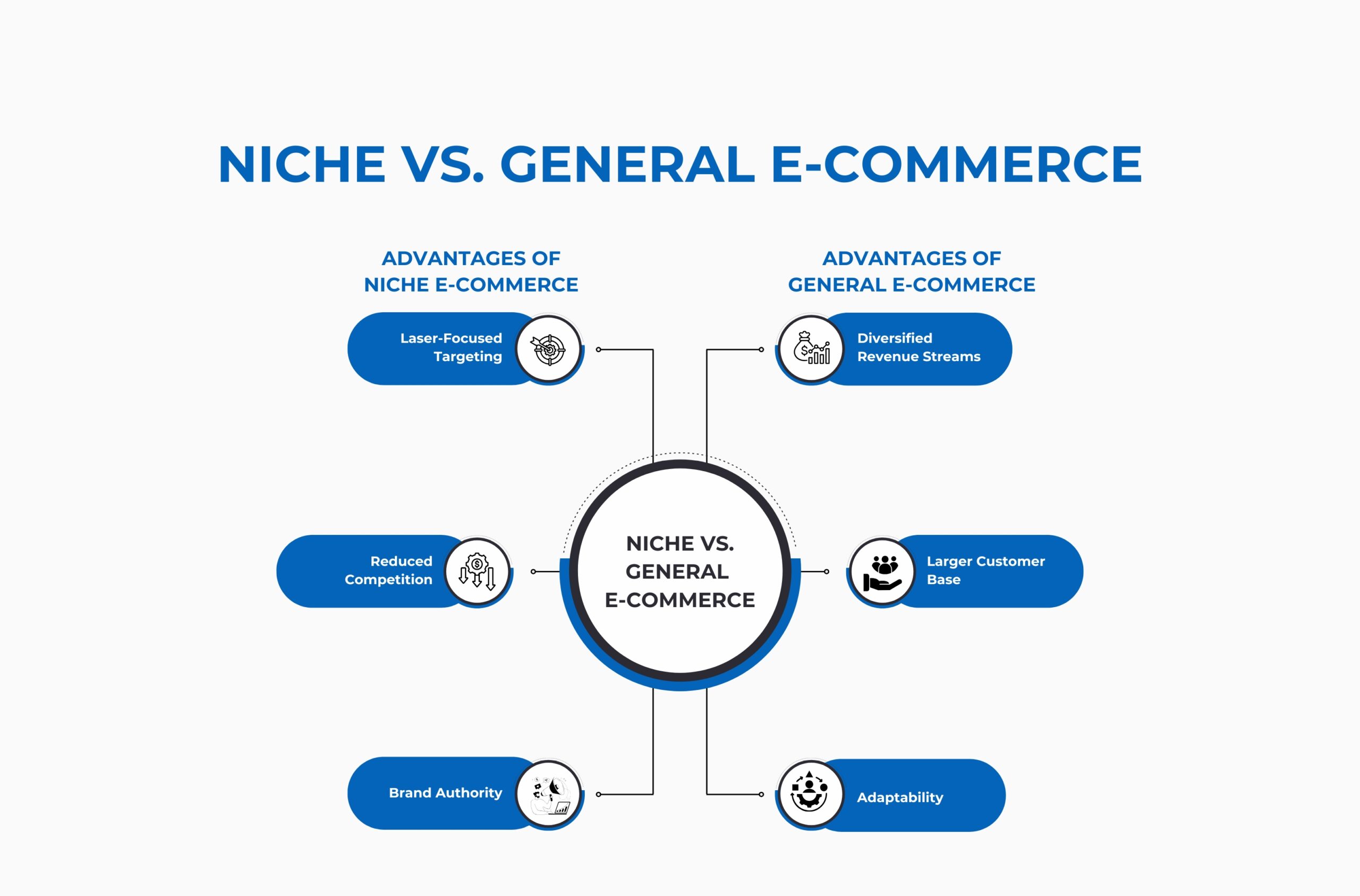
    Advantages of Niche E-commerce


    1. Laser-Focused Targeting:

    Niche businesses can tailor their marketing efforts to a specific audience, leading to higher engagement and conversion rates. This targeting can include personalized messaging, product recommendations, and specialized content that resonates with the audience’s interests.

    2. Reduced Competition:

    By focusing on a narrow market segment, niche businesses often face less competition compared to general e-commerce players. This can lead to higher visibility and a better chance of establishing themselves as industry experts.

    3. Brand Authority In Niche e-commerce

    Niche businesses can position themselves as authorities in their field, building a strong brand reputation and loyal customer base. This authority can translate into higher customer trust and long-term success.

    4. Personal Connection:

    Niche businesses have the opportunity to develop a personal connection with their customers. By understanding their specific needs and preferences, niche businesses can offer personalized experiences that foster customer loyalty.

    5. Product Differentiation:

    Niche products are often unique or specialized, allowing businesses to stand out based on the distinct value they provide. This differentiation can lead to higher perceived value and pricing flexibility.


    Niche E-commerce


    Advantages of General E-commerce


    General e-commerce, on the other hand, involves offering a wide range of products or services that cater to a broader audience. This approach has its own set of benefits:

    1. Diversified Revenue Streams: 

    General e-commerce businesses can tap into multiple product categories, reducing reliance on a single niche. This diversification can provide a safety net against market fluctuations.

    2. Larger Customer Base: 

    With a broader product range, general e-commerce businesses can attract a wider customer base. This increases the potential for higher sales volumes and revenue.

    3. Adaptability: 

    General e-commerce businesses can more easily adapt to changing market trends. If one product category experiences a decline, the business can shift its focus to other profitable areas.

    4. Economics of Scale: 

    With larger product volumes, general e-commerce businesses may benefit from economies of scale, leading to potential cost savings in areas such as inventory management and shipping.

    5. Cross-Selling and Upselling: 

    General e-commerce businesses have the advantage of cross-selling and upselling opportunities. Customers who purchase one product might be enticed to explore other offerings, leading to increased average order values.


    Factors to Consider


    The decision to pursue a niche or general e-commerce approach depends on various factors, including your business goals, resources, and market insights. Consider the following factors when making your choice:

    1. Expertise and Passion:

    If you’re deeply knowledgeable and passionate about a specific niche, it might be the ideal path for you. Niche businesses often require a deep understanding of the industry to deliver value and build trust.

    2. Market Demand:

    Conduct thorough market research to determine the demand for your chosen niche. Is there a sufficient audience interested in the products or services you plan to offer?

    3. Competition Analysis In Niche E-commerce

    Assess the level of competition in your chosen niche. High competition might require unique strategies to differentiate your business and gain a foothold.

    4. Long-Term Visibility:

    Consider whether your chosen niche is likely to remain relevant and profitable in the long run. Market trends and consumer preferences can evolve.

    5. Resource Allocation:

    Evaluate the resources you have available, including budget, time, and manpower. Niche businesses might require specialized marketing and product development efforts.

    6. Risk Tolerance:

    Niche businesses might have a more defined customer base, which could pose risks if that audience shrinks. General e-commerce might provide more stability due to a broader market.

    7. Scalability:

    Consider whether your chosen approach can scale as your business grows. Niche businesses might have limitations in terms of growth potential.


    Finding the Middle Ground: Hybrid Approach


    In some cases, entrepreneurs opt for a hybrid approach that combines elements of both niche and general e-commerce. This involves starting with a specific niche and gradually expanding the product range over time. This approach allows you to build a strong foundation within a niche while retaining the flexibility to diversify as your business gains traction.


    Conclusion


    The choice between niche and general e-commerce hinges on your strengths, resources, market insights, and business goals. Niche e-commerce offers the opportunity for specialization, authority, and a strong connection with a targeted audience. General e-commerce provides diversification, a larger customer base, and adaptability to market shifts.

    Ultimately, success in either approach relies on delivering value, understanding your customers, and staying agile in a dynamic e-commerce landscape. Whether you decide to carve a niche or embrace the breadth of possibilities, thorough research, and a clear business strategy will be your guiding lights on the path to e-commerce success.


    Frequently Asked Questions (FAQs)


    1. What are the advantages of niche e-commerce?

    Advantages include a focused customer base, less competition within the niche, the ability to build a strong brand identity, and the potential for higher profit margins.


    1. What are the advantages of general e-commerce?

    Advantages include a larger potential customer base, versatility in product offerings, and the ability to adapt to changing market trends.


    1. How do I choose between niche and general e-commerce for my business?

    Consider your expertise and passion, market research, competition, and your target audience’s needs and preferences when deciding which approach is best for your business.


    1. Which one is more profitable, niche or general e-commerce?

    Profitability depends on various factors, including market demand, competition, and the quality of your products. Niche e-commerce can be profitable if there’s a dedicated customer base, while general e-commerce may require more extensive marketing.  

  • What is Marketing Social Responsibility and its Strategies

    The traditional boundaries between business and society are becoming blurred. Consumers today are not just looking for products and services, they’re seeking brands that align with their values and contribute positively to the world. 

    This evolving landscape has given rise to the concept of “Marketing Social Responsibility” (MSR), where brands leverage their marketing strategies to not only promote their offerings but also drive social impact. In this blog, we will discuss the essence of Marketing Social Responsibility and its significance in shaping the future of business.


    Defining Marketing Social Responsibility


    Marketing Social Responsibility refers to the deliberate efforts of brands to incorporate social and ethical considerations into their marketing strategies. It goes beyond the traditional focus on profit generation to encompass a brand’s role in fostering positive change and addressing societal challenges. MSR involves using the reach and influence of marketing campaigns to promote social causes, sustainable practices, and ethical values.


    The Intersection of Profit and Purpose


    Historically, the primary goal of businesses was to generate profit. However, as global challenges such as climate change, inequality, and social injustice came to the forefront, consumer expectations shifted. People began demanding more from the brands they supported, expecting them to play a proactive role in addressing these issues. This led to a shift from a profit-centric model to a purpose-driven approach.

    Marketing Social Responsibility provides a powerful way to bridge the gap between profit and purpose. By aligning their marketing efforts with social causes, brands can build deeper connections with consumers, fostering brand loyalty and driving positive societal impact simultaneously.


    Strategies for Effective Marketing Social Responsibility


    1. Cause Integration: Brands can integrate social causes into their marketing campaigns, creating mutually beneficial partnerships. For instance, a clothing brand can collaborate with a charity organization to donate a portion of sales to a cause related to poverty alleviation. This approach not only raises awareness for the cause but also humanizes the brand.
    1. Transparency and Authenticity: In an era of information transparency, consumers value authenticity. Brands that openly share their social responsibility initiatives, along with the progress they’re making, build trust with their audience. Authenticity in communicating these efforts is crucial to avoiding accusations of “greenwashing” and building long-lasting connections.
    1. Storytelling for Impact: Stories have the power to evoke emotions and inspire action. Brands can leverage storytelling in their marketing campaigns to highlight real-world instances where their social responsibility initiatives have made a difference. These stories create a personal connection with consumers, encouraging them to participate in the brand’s mission.
    1. Inclusive Campaigns: Marketing Social Responsibility also involves promoting inclusivity and diversity. Brands that showcase people from different backgrounds in their campaigns send a message of acceptance and unity. This resonates with consumers who appreciate brands that celebrate and respect individual differences.
    1. Empowerment and Awareness: Brands can use their marketing prowess to raise awareness about critical social issues. Educational campaigns not only inform the public but also empower individuals to take action. For example, a health-oriented brand could run campaigns on healthy lifestyle choices, thereby contributing to a healthier society.


    The Benefits of Marketing Social Responsibility


    1. Enhanced Brand Image: Brands that engage in Marketing Social Responsibility efforts are perceived as more socially conscious and caring. This positive brand image translates to increased consumer loyalty and preference.
    1. Deeper Consumer Connections: Consumers are more likely to connect with brands that stand for something beyond profit. MSR provides a platform for brands to establish emotional connections with their audience, fostering long-term relationships.
    1. Competitive Advantage: As consumers become more socially conscious, brands that prioritize social responsibility gain a competitive edge. Consumers are more likely to choose a brand that aligns with their values.
    1. Positive Societal Impact: The most significant benefit of MSR is the potential for positive societal change. When brands use their influence to promote social causes, they contribute to creating a better world.


    Challenges and Ethical Considerations


    While Marketing Social Responsibility has numerous benefits, it’s not without challenges:

    1. Authenticity Concerns: Brands must genuinely commit to the causes they support. Inauthentic efforts can lead to backlash and damage the brand’s reputation.
    1. Balancing Profit and Impact: Brands need to strike a balance between their profit-driven objectives and their social responsibility goals. It’s crucial to avoid compromising one for the other.
    1. Accusations of Exploitation: Brands need to be cautious about not exploiting sensitive social issues for marketing gain. Any attempt to capitalize on tragedies or hardships can backfire.
    1. Measuring Impact: Measuring the actual impact of social responsibility initiatives can be complex. Brands need to invest in rigorous monitoring and evaluation to ensure their efforts are effective.


    Conclusion

    Marketing Social Responsibility is a transformative approach that aligns brands with the values of their consumers and the needs of society. By integrating social causes, promoting transparency, and telling impactful stories, brands can create meaningful connections and drive positive change. 

    The shift towards Marketing Social Responsibility signifies an ideal change in business operations, one where purpose and profit are harmonized for the betterment of all.


    Frequently Asked Questions (FAQs)


    1. Why is MSR important for businesses?

    MSR can enhance brand reputation, attract socially-conscious consumers, and create a competitive advantage. It fosters long-term sustainability, improves employee engagement, and can lead to financial benefits.


    1. Can small businesses engage in MSR?

    Absolutely, MSR isn’t limited to large corporations. Small businesses can engage in social responsibility by supporting local causes, adopting sustainable practices, and sharing their efforts with their communities.


    1. Is MSR a long-term strategy for businesses?

    Yes, MSR is a long-term strategy. It involves a commitment to ethical and sustainable practices that can benefit both the business and society over time.


    1. What are some potential challenges in implementing MSR?

    Challenges may include resource constraints, the need for cultural change within the organization, and effectively communicating MSR efforts to stakeholders.


    1. How can a company measure the success of its MSR efforts?

    Success can be measured through various metrics, including increased brand awareness, customer loyalty, employee satisfaction, and the social or environmental impact achieved.

  • Social Responsibility in Marketing: How Brands Could Make a Positive Impact?


    In an era characterized by increasing consumer awareness and demand for ethical business practices, the concept of Social Responsibility in Marketing has taken center stage. Brands are not only expected to deliver quality products and services but also to contribute positively to society. 

    In this article, we will discuss the significance of social responsibility in marketing and explore strategies that brands can adopt to make a lasting and positive impact on their bottom line and the world.


    Understanding Social Responsibility in Marketing


    Social responsibility in marketing refers to a company’s commitment to conducting its operations with consideration for the social and environmental impact it has on society. It involves aligning business practices with ethical and moral standards while striving to make a positive contribution to the community and the planet. 

    This responsibility extends beyond mere compliance with regulations and laws, aiming to proactively address social issues and concerns.


    The Evolution of Social Responsibility in Marketing


    Historically, businesses were primarily concerned with profit generation. However, as societies became more interconnected and consumers more informed, a shift occurred. Brands began recognizing their potential to influence social change and started embracing social responsibility in their marketing efforts.

    Socially responsible marketing involves incorporating ethical considerations and community-oriented initiatives into a brand’s messaging and actions. This approach acknowledges that a brand’s success is intertwined with the well-being of the communities it serves.


    Building Authentic Connections


    The foundation of effective social responsibility in marketing lies in building authentic connections with consumers. This means going beyond mere lip service and aligning marketing efforts with genuine efforts to create positive change. When brands demonstrate authenticity in their commitments, consumers are more likely to develop a sense of loyalty and trust.


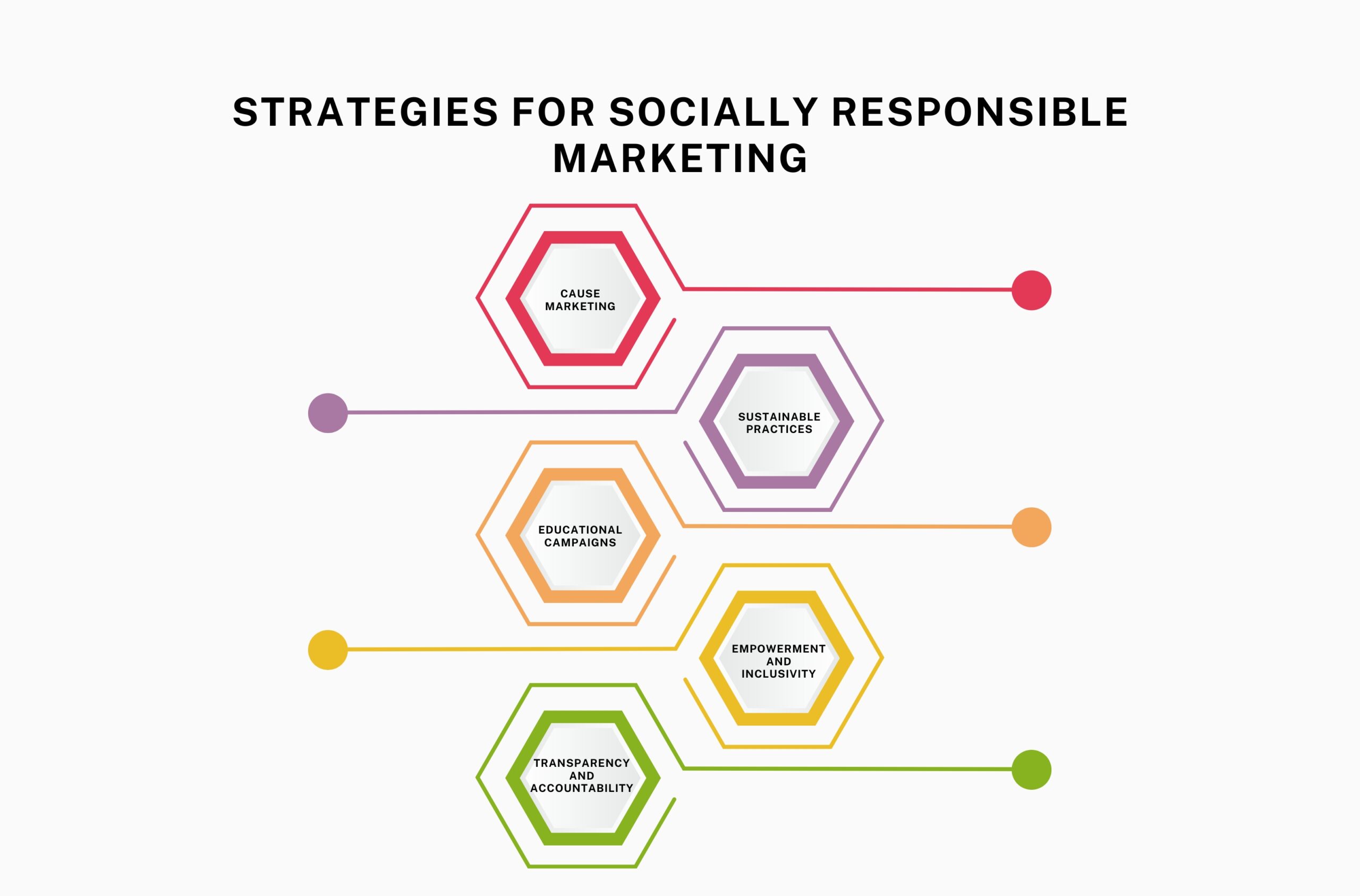
    Strategies for Socially Responsible Marketing


    1. Cause Marketing

    Cause marketing involves partnering with charitable organizations or social causes to create campaigns that benefit both the cause and the brand. This approach not only raises awareness for the cause but also positions the brand as one that cares about making a difference.

    For example, TOMS Shoes pioneered the “One for One” campaign, promising to donate a pair of shoes to a child in need for every pair purchased. This initiative demonstrated their commitment to social responsibility and resonated with consumers who wanted their purchases to have a positive impact.


    2. Sustainable Practices

    Embracing sustainable practices in manufacturing and sourcing material not only reduces a brand’s environmental footprint but also appeals to environmentally conscious consumers. Brands that prioritize sustainability can highlight their efforts in marketing campaigns, showcasing their commitment to the planet.


    3. Transparency and Accountability

    Openly sharing information about business practices, supply chains, and labor conditions demonstrates transparency and a commitment to ethical operations. Brands that are accountable for their actions, both positive and negative, build credibility with consumers who value honesty.


    4. Empowerment and Inclusivity

    Marketing campaigns that celebrate diversity, inclusivity, and empowerment resonate with a wide range of consumers. Brands that actively work to dismantle stereotypes and create platforms for marginalized voices can foster positive social change through their marketing efforts.


    5. Educational Campaigns

    Educational campaigns aim to raise awareness about social issues and encourage positive behavior changes. Brands can leverage their marketing reach to educate the public and encourage actions that contribute to a better society.


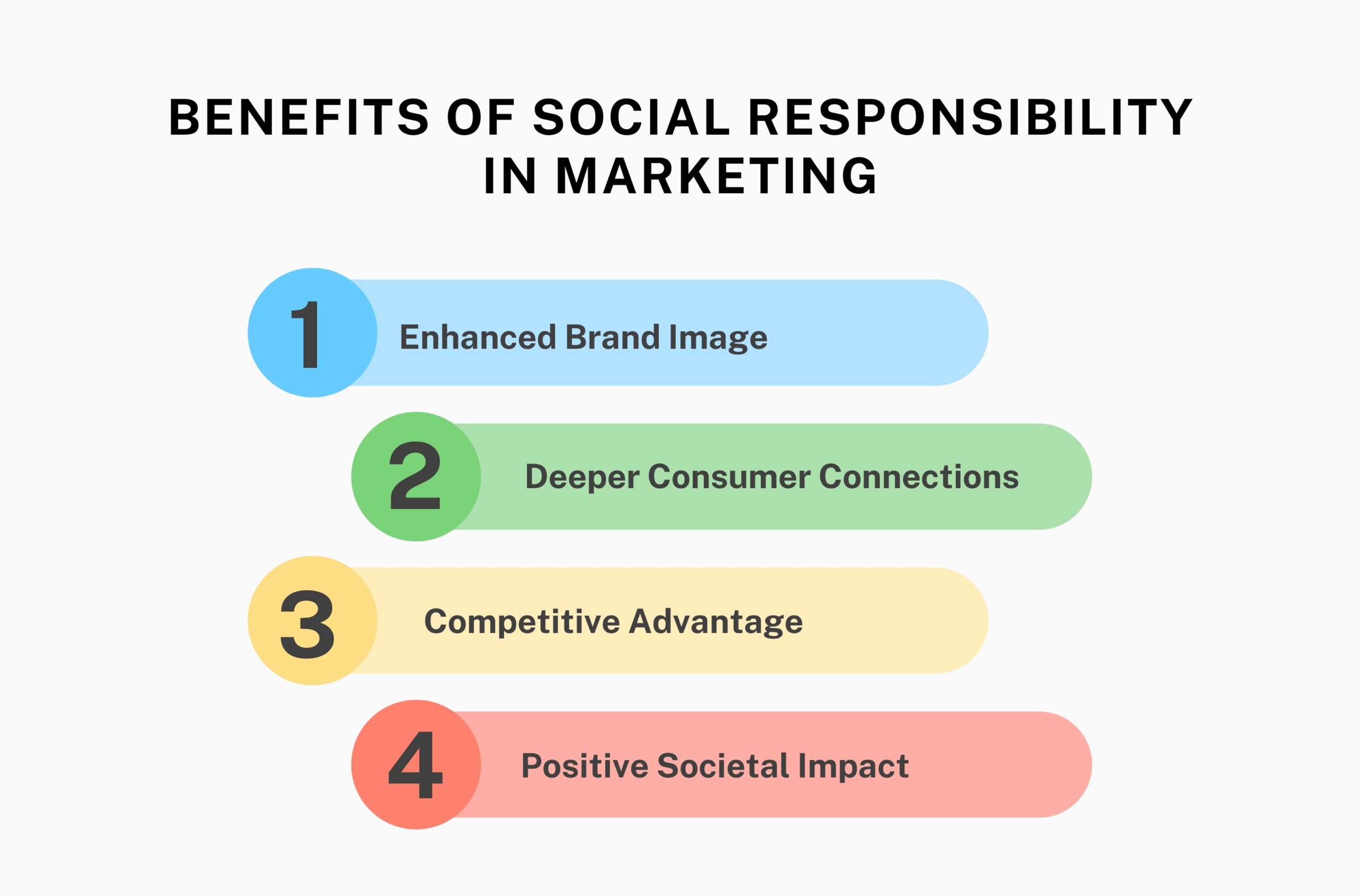
    Benefits of Social Responsibility in Marketing


    Social responsibility in marketing


    Embracing social responsibility in marketing offers numerous benefits for both brands and society as a whole:

    1. Enhanced Brand Image: Brands that actively contribute to societal well-being are viewed more favorably by consumers, leading to increased brand loyalty and positive associations.
    1. Competitive Advantage: Ethical practices and a commitment to social responsibility can set brands apart in competitive markets.
    1. Increased Consumer Engagement: Meaningful campaigns that resonate with consumers’ values lead to higher engagement and participation.
    1. Long-Term Sustainability: Brands that prioritize social responsibility are more likely to build a sustainable and enduring business model.
    1. Positive Impact: Most importantly, socially responsible marketing allows brands to play an active role in addressing societal challenges and making the world a better place.


    Challenges and Considerations


    While the benefits are significant, socially responsible marketing is not without its challenges. Brands must carefully navigate potential pitfalls, such as accusations of “greenwashing” (making false or exaggerated claims about sustainability efforts) and the risk of appearing opportunistic. Authenticity and a genuine commitment to change are essential to overcoming these challenges.


    Conclusion


    As consumers continue to demand more from the brands they support, the importance of social responsibility in marketing cannot be overstated. Brands that recognize their role in shaping society and take meaningful steps to contribute positively are likely to thrive in the long run. 

    By adopting strategies like cause marketing, embracing sustainability, fostering inclusivity, and promoting transparency, brands can create a positive impact that resonates far beyond their products and services. In a world where consumer choices can drive social change, socially responsible marketing isn’t just an option – it’s a powerful tool for creating a better future.


    Frequently Asked Questions (FAQs)


    1. What is Social Responsibility in marketing?

    Social responsibility in marketing refers to a company’s commitment to conducting its marketing activities in an ethical and socially conscious manner, taking into account the impact on society and the environment.


    1. Why is social responsibility important in marketing?

    Social responsibility is important in marketing because it helps build trust with consumers, attracts ethically conscious customers, provides a competitive advantage, and enhances a company’s reputation.


    1. What are some examples of sustainable marketing practices?

    Sustainable marketing practices include using eco-friendly materials, reducing waste in packaging, and promoting energy-efficient production processes. Companies can also highlight their sustainability efforts in marketing campaigns.


    1. What does social responsibility benefit a company’s brand image?

    Social responsibility can enhance a company’s brand image by showing that it cares about more than just profits. It can lead to increased consumer trust, positive public relations, and differentiation in the market.


    1. Can Social responsibility in marketing help attract investors?

    Yes, investors are increasingly interested in companies with strong social responsibility practices. Demonstrating a commitment to ethical and sustainable business can attract socially responsible investors and positively impact a company’s stock performance.