Category: SEO

  • Search Engine Optimization: Techniques for Higher Rankings

    What is SEO?

    SEO stands for Search Engine Optimization. It refers to the practice of optimizing a website and its contents to improve its visibility and rankings in search engine results pages (SERPs). The primary objective of SEO is to drive organic or unpaid traffic to a website by making it more accessible to search engines and appealing to users. It is one of the key components of successful online strategies.

    Search engines like Google, Bing, and Yahoo use complex algorithms to determine the relevance and quality of websites when users enter search queries. SEO techniques help websites align with these algorithms and increase their chances of appearing prominently in search results for relevant keywords.

    The goal of SEO is to make a website more visible to its target audience by improving its search engine rankings. When a website ranks higher in search results, it tends to receive more clicks and organic traffic, which can lead to increased brand exposure, higher conversion rates, and business growth.

    It’s important to note that SEO is an ongoing procedure, as search engine algorithms are constantly evolving. Staying updated with the latest SEO best practices and adapting strategies accordingly is crucial for long-term success in improving website rankings and driving organic traffic.

    Strategies to enhance your online visibility:

    1. Keyword Research and Optimization:

    Keywords are the foundation of SEO. Conduct thorough keyword research to identify the terms and phrases your target audience is using to search for products or services related to your business. Utilize keyword research tools like Google Keyword Planner, SEMrush, or Moz to find relevant and high-volume keywords.

    Once you have identified your target keywords, optimize your website’s content accordingly. Incorporate keywords naturally into your page titles, meta descriptions, headings, and body content. However, avoid keyword stuffing, as it could damage your rankings. Focus on providing valuable and engaging content that caters to both search engines and users.

    2. High-Quality Content Creation:

    Creating high-quality, informative, and engaging content is crucial for SEO success. Search engines prioritize websites that offer valuable information to users. Develop a content strategy that aligns with your target audience’s needs and interests.

    Produce well-researched articles, blog posts, videos, and infographics that answer users’ questions and provide valuable insights. Use relevant keywords within your content, but ensure they flow naturally. Long-form content tends to perform well in search engine rankings, so aim for comprehensive and in-depth articles when possible.

    3. On-Page Optimization:

    Optimizing on-page elements is essential to improve your website’s visibility. Start by optimizing your website’s URL structure. Use descriptive and keyword-rich URLs that are easy for both search engines and users to understand.

    Next, optimize your page titles and meta descriptions. These elements should accurately represent the content of your pages and incorporate relevant keywords. Including compelling meta descriptions can also increase click-through rates.

    Pay attention to your website’s internal linking structure. Link relevant pages together using anchor text that includes keywords. Internal linking helps search engines understand the structures of your website and improves user navigation.

    4. Mobile-Friendly Optimization:

    With the increasing user of mobile devices, optimizing your website for mobile is no longer optional. Mobile-friendliness is now a ranking factor in search engine algorithms. Make sure that your website is responsive and adapts to different screen sizes. 

    Optimize page load speed, as slow-loading websites can negatively impact user experience and rankings. Test your website’s mobile-friendliness using tools like Google’s Mobile-Friendly Test and make necessary improvements.

    5. Backlink Building:

    Building high-quality backlinks is an essential SEO technique. Backlinks are links from other websites to your own, indicating that your content is valuable and trustworthy. Earn backlinks from authoritative and relevant websites through various strategies, such as guest blogging, creating compelling content, and reaching out to industry influencers.

    White Hat SEO vs. Black Hat SEO:

    White Hat SEO refers to ethical and legitimate techniques that align with search engine guidelines. It focuses on providing value to users and improving website visibility through organic means. 

    Conversely, Black Hat SEO employs unethical tactics that try to manipulate search engine algorithms for quick gains. Black Hat techniques can lead to penalties, loss of rankings, and even website bans. It’s crucial to adhere to White Hat SEO practices for sustainable and long-term success.

    Conclusion:

    Implementing effective SEO techniques is vital for achieving higher rankings in search engine results. By conducting thorough keyword research, creating high-quality content, optimizing on-page elements, ensuring mobile-friendliness, and building authoritative backlinks, you can enhance your website’s visibility and attract organic traffic. With dedication and consistency, you can achieve higher rankings and propel your online success.

    Frequently Asked Questions (FAQs)

    1. What is the role of content in SEO?

    Content is a crucial component of SEO. High-quality, relevant, and valuable content helps attract and engage users. It also provides opportunities to incorporate keywords and earn backlinks, both of which positively impact SEO.

    1. What are backlinks, and why are they important for SEO?

    Backlinks are links from other websites to yours. They are important for SEO because search engines consider them as votes of confidence in your content. High-quality backlinks from reputable websites can improve your website’s authority and search rankings.

    1. How long does it take to see results from SEO efforts?

    The timeline for seeing SEO results can vary widely. It depends on factors like the competiveness of your industry, the quality of your SEO efforts, and the authority of your website. Generally, it may take several months to see significant improvements.

    1. What are keywords, and how do I choose them for SEO?

    Keywords are words or phrases that users type into search engines to find information. To choose keywords for SEO, research relevant terms related to your content or industry, consider search volume and competition, and select keywords that match user intent.

    1. How do search engines like Google determine website rankings?

    Search engines use complex algorithms to determine website rankings. These algorithms take into account various factors, including the relevance and quality of content, website structure, backlinks, user experience, and more.

  • The Evolution of Voice Search and Its Implications for SEO

    Introduction:

    In recent years, voice search has rapidly gained popularity as a convenient and hands-free way to access information. Thanks to advancements in voice recognition technology, virtual assistants like Siri, Alexa, and Google Assistant have become an integral part of our daily lives. As voice search continues to evolve, it brings significant implications for Search Engine Optimization (SEO) strategies. In this article, we will explore the evolution of voice search and discuss its implications for SEO professionals and website owners.

    The Rise Voice Search:

    Voice search has experienced remarkable growth and adoption. The widespread use of smartphones and the proliferation of smart speakers and other voice-enabled devices have contributed to its popularity. People are increasingly using voice commands to perform a variety of tasks, from searching for information and making online purchases to controlling smart home devices and setting reminders.

    The Impact on SEO:

    The emergence of voice search has presented new challenges and opportunities for SEO professionals. Traditional SEO techniques that focused primarily on optimizing for text-based searches must now be adapted to accommodate voice queries. Let’s delve into some key implications.

    1. Conversational and Long-Tail Keywords:

    Voice searches tend to be more conversational and longer than traditional text-based searches. When typing, users typically use short, concise phrases, while voice search queries often resemble natural language. SEO professionals need to optimize their content to reflect this shift. Incorporating long-tail keywords and phrases that match the way people speak can help improve visibility in voice search results.

    2. Featured Snippets:

    Featured snippets are concise, direct answers to users’ queries that appear at the top of search engine result pages (SERPs). With voice search, virtual assistants often rely on featured snippets to provide immediate answers to users’ questions. SEO experts should optimize their content to increase the chances of appearing as a featured snippet. It includes structuring content to answer commonly asked questions and providing clear, concise information.

    3. Local SEO and Voice Search:

    Voice search is highly useful for finding local businesses and services. When users make voice queries like “Where is the nearest coffee shop?” or “What are the best restaurants near me?” search engines leverage location data to provide relevant results. To capitalize on this trend, local businesses should focus on optimizing their websites for local SEO, including accurate business information, location-specific keywords, and creating a presence on relevant online directories.

    4. Mobile Optimization:

    Voice search is closely tied to mobile devices, as smartphones and tablets are the primary means of interacting with virtual assistants. As a result, mobile optimization remains crucial for SEO success. Websites must be mobile-friendly, with fast loading times and responsive design. Optimizing for mobile enhances the user experience and improves search engine rankings, both for voice and text-based searches.

    5. Structured Data Markup:

    Structured data markup, also known as schema markup, provides search engines with additional information about the content on a website. Implementing structured data can enhance the visibility of search results and improve the chances of appearing as a featured snippet. SEO professionals should take advantage of schema markup to provide context and make their content more easily understandable to search engines.

    6. Contextual Relevance and User Intent:

    Understanding user intent and providing relevant content has always been critical for SEO. With voice search, the importance of context and intent is further emphasized. SEO experts must focus on creating content that matches user expectations and fulfills their needs. This entails conducting thorough keyword research, analyzing user behavior and preferences, and crafting content that directly addresses users’ queries.

    7. Natural Language Processing:

    As voice search technology improves, virtual assistants better understand complex queries and decipher user intent. SEO professionals must optimize their content for natural language processing, ensuring that it is easily comprehensible to both users and search engines. Writing in a conversational tone, using simple language, and providing direct answers can help align content with voice search requirements.

    Conclusion:

    Voice search is no longer a novelty; it has become a prominent part of how people interact with technology and search for information. The evolution of voice search has disrupted traditional SEO practices, emphasizing the need for a more conversational, user-focused approach. 

    SEO professionals and website owners must adapt their strategies to accommodate voice queries, incorporate conversational keywords, optimize for featured snippets, and enhance the mobile experience. By staying ahead of these changes, businesses can position themselves for success in the age of voice search.

    Frequently Asked Questions (FAQs)

    1. What are the benefits of voice search for users and businesses?

    For users, voice search offers convenience, faster information retrieval, and the ability to interact with devices hands-free. For businesses, it provides an opportunity to reach a wider audience and adapt to changing consumer search behaviors.

    1. How has voice search impacted search engine optimization (SEO)?

    Voice search has influenced SEO by emphasizing the importance of conversational and long-tail keywords. Websites and content optimized for voice search tend to perform better, as search engines aim to provide more relevant answers to spoken queries.

    1. Are there privacy concerns associated with voice search technology?

    Yes, privacy concerns exist with voice search, as voice assistants and devices often record and store voice interactions. Users should be aware of privacy settings and choose what data they are comfortable sharing.

    1. What does the future of voice search look like?

    The future of voice search is expected to involve even more seamless integration with various devices and applications. It may also incorporate advanced features like multi-turn conversations and personalized responses.

    1. Is voice search replacing traditional text-based search?

    Voice search is not replacing text-based search but it complementing it. Text-based search is still crucial for many types of queries, but voice search is becoming increasingly important, especially for mobile and hands-free interactions.

  • Local SEO Tips to Attract Nearby Customers to Your Store

    Introduction:

    In the digital age, local businesses face the challenge of standing out in a crowded marketplace dominated by online giants. As customers increasingly turn to search engines to find local products and services, implementing effective local SEO strategies becomes paramount for brick-and-mortar businesses. Local SEO focuses on optimizing a business’s online presence to connect with potential customers in its geographical vicinity. 

    By leveraging local SEO strategies, brick-and-mortar businesses can enhance visibility, attract local customers, and thrive in the competitive local market. In this blog, we will delve into the essential local SEO strategies that can help local businesses effectively reach and engage with their target audience.

    1. Optimize Google My Business (BGM) Listing:

    Google My Business is a free tool provided by Google that allows businesses to create and manage their online presence on Google Search and Maps. It is a fundamental element of local SEO for brick-and-mortar businesses. To optimize your GMB listing:

    1. Claim and verify your business: Claim your GMB listing and verify the accuracy of your business information.
    2. Provide complete and accurate details: Ensure your business name, address, phone number (NAP), website, operating hours, and categories are accurate and up-to-date.
    3. Add photos and videos: Include high-quality images and videos showcasing your products, services, and the interior and exterior of your business.
    4. Encourage customer reviews: Positive reviews can enhance your local search ranking and build trust with potential customers.

    2. Local Keyword Research:

    Conduct thorough keyword research to identify the search terms potential customers use when looking for products or services in your local area. Include location-based keywords, such as city names, neighbourhoods, or landmarks, in your website’s content, meta tags, and headings. Long-tail keywords that reflect specific local queries can also be valuable for attracting highly relevant local traffic.

    3. On-Page Optimization:

    Optimize your website’s content to align with local SEO best practices. Create location-specific landing pages for different branches or locations of your business, if applicable. Include your NAP on every page of your website, preferably in the footer, to ensure consistency. Use schema markup to help search engines understand your business information better and display rich snippets in search results.

    4. Local Citations and Online Directories:

    Local citations, which are mentions of your business name, address, and phone number on external websites, play a crucial role in local SEO. Ensure your business information is consistent and up-to-date across various online directories, local business listings, and review sites. This consistency establishes trust with both customers and search engines.

    5. Mobile Optimizations:

    As mobile device usage continues to grow, optimizing your website for mobile devices is non-negotiable for local SEO success. Ensure your website is responsive, loads quickly, and offers a seamless user experience on mobile devices. Mobile-friendly websites are more likely to rank higher in local search results, as Google prioritizes mobile-first indexing.

    6. Local Content Marketing:

    Content marketing remains a powerful strategy for attracting and engaging local customers. Create high-quality, informative, and locally-relevant content that resonates with your target audience. Consider publishing blog posts, articles, or guides that highlight local events, news, or community involvement. Engaging content is more likely to be shared, enhancing your brand’s visibility in the local community.

    7. Build Local Backlinks:

    Backlinks from reputable local websites can boost your website’s authority and improve local search rankings. Reach out to local business partners, organizations, or community events and request backlinks to your website. Sponsor local events or charities to earn backlinks from their websites.

    8. Encourage Online Reviews and Ratings:

    Positive online reviews and ratings play a significant role in attracting local customers. Encourage satisfied customers to leave reviews on your GMB listing and other review platforms. Respond promptly to reviews, both positive and negative, to demonstrate your commitment to customer satisfaction.

    9. Local Social Media Engagement:

    Engage with the local community on social media platforms. Share updates about your business, promotions, and events. Respond to comments and messages promptly, fostering a sense of community and approachability. Social media interactions can indirectly impact your local search rankings and build brand loyalty.

    10. Monitor Local SEO Performance:

    Regularly monitor the performance of your local SEO efforts. Use tools like Google Analytics and Google Search Console to track website traffic, user behavior, and keyword performance. Analyze the data to identify areas of improvement and refine your local SEO strategies accordingly.

    Conclusion:

    For brick-and-mortar businesses, local SEO is game-changer, enabling them to connect with local customers effectively and compete in the digital marketplace. By optimizing their Google My Business listing, conducting local keyword research, and focusing on on-page optimization local businesses can improve their online visibility. Consistency in local citations, mobile optimization, and engaging content marketing further strengthens their local SEO efforts.

    Building local backlinks, encouraging online reviews, and maintaining and active presence on social media contribute to building trust and loyalty among the local audience. By implementing these essential local SEO strategies, brick-and-mortar businesses can successfully bridge the gap between the digital and physical worlds, fostering lasting relationships with their local customers and ensuring sustainable growth.

  • SEO Tactics Every Startup Should Implement for Online Success

    In today’s digital age, having an online presence is essential for the success of any startup. Search Engine Optimization (SEO) plays a pivotal role in driving organic traffic to your website and increasing brand visibility. Implementing effective SEO tactics can greatly impact a startup’s online success. In this blog, we will explore some key SEO strategies that every startup should consider to achieve online success

    1. Keyword Research and Strategy

    Keyword research is the foundation of any successful SEO campaign. Start by identifying relevant keywords and phrases that your target audience is likely to use when searching for products or services related to your startup. Utilize keyword research tools to uncover high-volume, low-competition keywords. Develop a well-defined keyword strategy that guides your content creation efforts, ensuring that you’re addressing the specific needs of your audience.

    2. High-Quality Content Creation

    Creating high-quality, valuable content is a cornerstone of effective SEO. Develop content that provides solutions, answers questions, and addresses the pain points of your target audience. Content can take various forms, including blog posts, videos, infographics, and more. The key is to offer content that establishes your startup as an authority in your industry, making visitors more likely to stay on your site, engage with your content, and convert into customers.

    3. On-Page Optimization

    On-page optimization involves optimizing individual web pages to improve their search engine rankings and drive relevant traffic. This includes optimizing title tags, meta descriptions, and header tags, and incorporating targeted keywords naturally within the content. Ensure your website’s structure is user-friendly and easy to navigate, enhancing the overall user experience.

    4. Mobile-Friendly Design

    With the majority of internet users accessing websites through mobile devices, having a mobile-friendly design is crucial. Google considers mobile-friendliness as a ranking factor, making responsive design essential for SEO success. A website that is easy to use on both desktop and mobile devices enhances user experience and increases the likelihood of higher search rankings.

    5. Link Building

    Link building is about acquiring high-quality backlinks from reputable websites in your industry. Backlinks signal to search engines that your content is valuable and trustworthy. Focus on building relationships with influencers, industry leaders, and other websites through guest posting, partnerships, and outreach. Quality matters more than quantity when it comes to link building, so prioritize authoritative and relevant backlinks.

    6. Local SEO

    For startups with a physical presence or those targeting local customers, local SEO is vital. Optimize your Google My Business profile, ensure accurate NAP (Name, Address, and Phone Number) information across the web, and encourage customer reviews. This helps your startup appear in local search results when potential customers are looking for products or services in your area.

    7. Page Speed Optimization

    Page speed is crucial for user experiences but also impacts search engine rankings. Slow-loading websites can lead to high bounce rates and lower search visibility. Compress images, minimize code, leverage browser caching, and use Content Delivery Networks (CDNs) to improve your website’s loading times. Google’s Page Speed Insights can provide insights and suggestions for optimizing your website’s speed.

    8. User Experience and Engagement

    Search engines value user experience and engagement metrics. A website that keeps visitors engaged and encourages them to spend more time on-site can have a positive impact on your SEO efforts. Incorporate interactive elements, easy navigation, clear calls-to-action, and relevant internal linking to guide users through your website and reduce bounce rates.

    9. Technical SEO

    Technical SEO involves optimizing the technical aspects of your website to ensure it is accessible to search engines. It includes optimizing site structure, XML sitemaps, robots.txt files, and schema markup. A well-structured website with clean code and proper indexing ensures that search engines can crawl and understand your content effectively.

    10. Analytics and Continuous Improvement 

    Regularly monitor and analyze your website’s performance using tools like Google Analytics. Track key metrics such as organic traffic, bounce and conversion rates, and keyword rankings. Use this data to identify areas for improvement and refine your SEO strategies accordingly. SEO is an ongoing process. So staying informed about the latest industry trends and algorithm updates is essential.

    In conclusion, implementing effective SEO tactics is essential for the online success of startups. A well-crafted SEO strategy that includes keyword research, high-quality content creation, on-page optimization, mobile friendliness, link building, local SEO, page speed optimization, user experience enhancement, technical SEO, and continuous improvement can significantly impact a startup’s visibility and growth in the digital landscape. 

    By prioritizing these tactics, startups can establish a strong online presence, attract relevant organic traffic, and ultimately achieve their business goals.

    Frequently Asked Questions (FAQs)

    1. How can I choose the right keywords for my startup’s SEO strategy?

    Start by conducting keyword research to identify relevant keywords and phrases related to your business. Tools like Google Keyword Planner and SEMrush can help you find keywords with high search volume and low competition. 

    1. Is content marketing essential for SEO, and how can startups approach it?

    Yes, content marketing is integral to SEO success. Startups should create high-quality, informative, and engaging content that addresses the needs and questions of their target audience. Blog posts, videos, infographics, and e-books can all be part of a content marketing strategy.

    1. Do backlinks still matter for SEO?

    Yes, backlinks (links from other websites to yours) are still crucial for SEO. They indicate authority and trustworthiness to search engines. Focus on building high-quality, relevant backlinks through guest posting, partnerships, and creating shareable content.

    1. How can startups measure the effectiveness of their SEO efforts?

    Startups can use tools like Google Analytics and Google’s Search Console to track website traffic, keyword rankings, click-through rates, and user engagement. The metrics can help gauge the impact of SEO strategies.

    1. Should startups invest in local SEO, and how can they do it effectively?

    Yes, local SEO is vital for startups with a physical presence. Claim and optimize your Google My Business listing, encourage customer reviews, and ensure your NAP (Name, Address, Phone number) information is consistent across online directories.

  • Understanding LSI Keywords for Enhanced SEO

    In the world of Search Engine Optimization (SEO), staying ahead of the curve is essential. One of the advanced techniques gaining prominence is the use of Latent Semantic Indexing (LSI) Keywords. LSI keywords have the potential to not only improve your website’s search engine rankings but also enhance the overall user experience.

    In this blog, we’ll delve into the concept of LSI keywords, their importance, and how to effectively incorporate them into your content strategy.

    What are LSI Keywords?

    Latent Semantic Indexing (LSI) is a technology that search engines use to understand the context and meaning behind words used in a search query. Rather than relying solely on exact keyword matches, LSI keywords help search engines identify related terms and concepts. This enables them to provide more accurate and relevant search results to users.

    For instance, if someone searches for “apple,” search engines equipped with LSI technology can determine whether the user is looking for information about the fruit or the tech company based on the surrounding context of the search query.

    Importance of LSI Keywords in SEO

    1. Enhanced Relevance: 

    LSI Keywords assist search engines in understanding the overall theme of your content. By incorporating related terms, your content becomes more contextually rich and relevant, increasing the chances of ranking higher in search results.

    2. Diverse Keyword Usage: 

    Overusing a single keyword can lead to keyword stuffing, which is penalized by search engines. LSI keywords offer an opportunity to naturally incorporate variations of your main keyword, maintaining a balanced keyword density.

    3. Content Depth and Quality: 

    Including LSI keywords encourages content creators to cover a topic comprehensively. This leads to in-depth and informative articles, which tend to attract more backlinks and shares, further boosting your SEO efforts.

    How does LSI Keyword work?

    Latent Semantic Indexing (LSI) is a technology used by search engines to analyze and understand the relationships between words, concepts, and context within a piece of content. LSI plays a crucial role in how this technology works. Here’s how LSI keywords function:

    1. Contextual Analysis:

    LSI technology is designed to recognize patterns in language usage. It goes beyond exact keyword matches and takes into account the surrounding words and phrases to determine the context and meaning of a piece of content.

    2. Building a Semantic Map: 

    Search engines use complex algorithms to create a “semantic map” of words and their relationships. This map helps search engines understand the various ways words can be related to each other within a specific context.

    3. Identifying Relationships: 

    LSI algorithms analyze large amounts of text from the web to identify how certain words tend to appear together. For example, if the word “apple” frequently appears alongside terms like “fruit,” “orchard,” and “crunchy,” the algorithms learn that these words are semantically related.

    4. Topic Associations: 

    LSI keywords help search engines associate content with specific topics or concepts. When you include LSI keywords in your content, the search engine can better understand the main theme and context of your article.

    5. User Intent Matching: 

    LSI technology helps search engines understand the intent behind a user’s search query. By identifying the relationships between terms, the search engine can provide more relevant search results that align with what the user is looking for.

    Finding and Incorporating LSI Keywords

    1. Keyword Research: 

    Begin by conducting thorough keyword research using tools like Google Keywords Planner, SEMrush, or Ahrefs. Identify your primary keyword, and these tools will often provide a list of related keywords that can be used as LSI keywords.

    2. Semantic Searches: 

    Perform a semantic search on search engines using your primary keyword. Scroll down to the “Searches related to” section at the bottom of the search results page. These suggestions are potential LSI keywords you can use.

    3. LSI keyword Generators: 

    Several online tools are designed specifically to generate LSI keywords for a given topic. These tools can save time and provide you with a broader range of related terms.

    Implementing LSI Keywords in Your Content

    1. Natural Flow: 

    LSI keywords should be incorporated seamlessly into your content. They should read naturally and contribute to the overall coherence of the price.

    2. Subheadings and Sections: 

    Use LSI keywords as subheadings or section titles. This not only improves the readability of your content but also signals to search engines that your articles cover a range of related concepts.

    3. Variety in Content: 

    LSI keywords should reflect the diversity of your content. Instead of repeating the same keywords, explore different angles and facets of your topic using these related terms.

    Monitoring and Adjusting

    SEO is an ongoing process, and the effectiveness of your LSI keywords should be monitored. Use tools like Google Analytics to track the performance of your content in terms of organic search traffic. If certain LSI keywords are driving more traffic than others, consider creating more content around those topics.

    In conclusion, embracing Latent Semantic Indexing (LSI) keywords can significantly elevate your SEO strategy. By enhancing relevance, diversifying keyword usage, and improving content quality. LSI keywords play a pivotal role in modern SEO. Effective research, seamless integration, and constant monitoring are key to harnessing the potential of LSI keywords and staying ahead in the competitive world of online search.

    Incorporating LSI keywords into your content strategy is not just about appeasing search engines; it’s about delivering valuable and relevant content to your audience, ultimately driving better engagement and higher search rankings. So, take the time to understand LSI keywords and leverage their power to enhance your SEO efforts.

    Frequently Asked Questions (FAQs)

    1. How does the LSI work?

    LSI analyzes the patterns of word usage within a set of documents to identify the underlying structure and semantics. It creates a mathematical representation of terms and documents, making it possible to understand the context and relationships between words.

    1. What is the purpose of using LSI in search engines?

    LSI helps search engines to improve the accuracy of search results by understanding the context of a user’s query and matching it to relevant documents, even if the exact keyword phrase isn’t present.

    1. Do I need to use LSI keywords in my content?

    While you don’t need to use specific LSI keywords, it’s beneficial to incorporate semantically related terms naturally into your content. This can improve the overall quality and relevance of your content to both users and search engines.

    1. Are there tools that can help with LSI keyword research?

    Yes, there are SEO tools and keyword research tools that can provide suggestions for LSI keywords. These tools analyze the top-ranking pages for a specific keyword and identify related terms.

    1. Is LSI still relevant in SEO today?

    Yes, LSI is still relevant in modern SEO. Search engines like Google continue to use advanced techniques to understand content, and incorporating semantically related terms can enhance your content’s quality and visibility.

  • Image SEO: Optimizing Visual Content for Search Engines

    Image SEO is an essential part of optimizing your online content for search engines and users alike. However, the significance of images extends beyond mere aesthetics. When optimized correctly, images can contribute to a website’s search engine optimization (SEO) efforts, boosting visibility, user engagement, and overall online success. 

    In this blog, we will delve into the world of image SEO, exploring the techniques and best practices for optimizing visual content to make it more search engine-friendly.

    Understanding Image SEO

    Image SEO, or image search engine optimization, is the practice of optimizing images to ensure they are easily discoverable by search engines and contribute positively to a website’s overall SEO strategy. Just as text-based content requires optimization for search engines, visual content demands a tailored approach to improve its visibility in search results.

    Image SEO involves various techniques and practices to make images more search engine-friendly and user-friendly. It aims to achieve better rankings in image search results, enhance user experience, and increase organic traffic from image searches.

    Why Image SEO Matters

    1. Enhanced User Experience: 

    High-quality and relevant images enhance the user experience, making content more engaging and memorable. When users have a positive experience on your website, they are more likely to stay longer and interact with your content, reducing bounce rates.

    2. Visual Search: 

    As visual search technology advances, search engines can now analyze and understand the content of images. Optimized images have a better chance of appearing in visual search results, broadening your online reach.

    3. Image Search Traffic: 

    A significant portion of online searches is image-driven. By optimizing your images, you tap into this potential source of organic traffic and increase the chances of attracting visitors interested in visual content.

    4. Reduced Page Load Time: 

    Image optimization often involves reducing the file size of images, which in turn improves page load speed. Fast-loading pages are favored by search engines and provide a better user experience.

    5. Image-Rich Snippets: 

    When images are optimized with structured data, they can appear as rich snippets in search results. These eye-catching snippets can lead to higher click-through rates and improved visibility.

    Key Elements of Image SEO

    1. File Name: 

    Choose descriptive file names that accurately reflect the content of the images. Instead of generic names like “image123.jpg,” opt for names that include relevant keywords, such as “blue-sunset-over-ocean.jpg.”

    2. Image Alt Text: 

    Alt text (alternative text) provides a text description of the image for those who cannot view it, such as screen readers for visually impaired users. Use descriptive alt text that conveys the image’s context and includes relevant keywords.

    3. Image Compression: 

    Reduce the file size of images without compromising quality. Compressed images load faster, which is crucial for both user experience and SEO.

    4. Image Format: 

    Choose the appropriate image format based on the content. JPEG is ideal for photographs, while PNG is better for images with transparency or text overlays.

    5. Responsive Design: 

    Ensure your website is responsive and displays images correctly on various devices and screen sizes. Mobile-friendliness is a crucial aspect of modern SEO.

    6. Image Sitemaps:

     Include images in your website’s XML sitemap to help search engines discover and index them effectively.

    Image SEO Best Practices

    1. Relevance: 

    Use images that are relevant to the content of the page. Irrelevant images can confuse users and dilute the focus of your content.

    2. Unique Images: 

    Whenever possible, use original images that you have the right to. Unique images add value and authenticity to your content.

    3. Image Captions: 

    Provide descriptive captions for images. Captions not only engage users but also provide another opportunity to include keywords.

    4. Avoid Text in Images: 

    Avoid using text images whenever possible. Text within images is not searchable by search engines, and it may also affect accessibility.

    5. Avoid Overloading: 

    While images enhance content, avoid overwhelming pages with too many images. Balance is key.

    Tools for Image SEO

    1. Image Editing Tools: 

    Tools like Adobe Photoshop, Canva, or GIMP can help you optimize and edit images for SEO.

    2. Image Compression Tools: 

    Tools like TinyPNG, ImageOptim, and Compressor.io help reduce image file sizes without compromising quality.

    3. Structured Data Generators: 

    Schema markup can enhance image SEO. Use tools like Google’s Structured Data Markup Helper to add structured data to your images.

    Conclusion

    In the modern digital landscape, images are more than just visual embellishments; they are valuable assets that can significantly impact your website’s SEO performance. By optimizing images with descriptive file names, alt text, compression, and adhering to best practices, you can enhance user experience, increase visibility in search results, and tap into the potential of visual search.

    As search engines continue to evolve and users seek richer content experiences, image SEO becomes an integral part of any comprehensive SEO strategy. So, invest the effort in optimizing your visual content, and watch as your images not only capture eyes but also boost your website’s online presence.

    Frequently Asked Questions (FAQs)

    1. What is the best image format for SEO: JPEG, PNG, or WebP?

    The best image format depends on the type of image and its intended use. JPEG is suitable for photographs, PNG for images with transparency, and WebP is a modern format known for its excellent compression and quality. Choose the format that best suits your content.

    1. Can images appear in Google Image Search results?

    Yes, images from your website can appear in Google Image Search results of they are properly optimized and indexed. Appealing in image search results can drive additional organic traffic to your website.

    1. How does image size affect SEO?

    Image size affects SEO in terms of page loading speed. Large, unoptimized images can slow down your website, leading to higher bounce rates and potentially lower search engine rankings. Optimizing image size helps improve page speed, which is a ranking factor for SEO.

    1. What is the purpose of alt text in Image SEO?

    Alt text, or alternative text, serves two main purposes in Image SEO. Firstly, it provides a description of the image for visually impaired users who rely on screen readers. Secondly, it provides context to search engines, helping them understand the content and context of the image, which can positively impact SEO.

    1. How should I write alt text for images?

    When writing alt text, be concise and descriptive. Include relevant keywords if they naturally fit the image’s function or content accurately. Avoid keyword stuffing or overly long alt text.

  • Local Seo tips that will increase your revenue in 2025

    In today’s digital age, having a strong online presence is essential for any business that wants to succeed, especially when it comes to targeting local customers. In this blog post, we’ll discuss the benefits of Local SEO, and some tips and strategies for optimizing your business’s online presence for local search. So whether you’re a small business owner looking to attract more local customers or a marketer trying to help your clients improve their local SEO, keep reading to learn more!

    What is Local SEO?

    Local SEO (Search Engine Optimization) is the practice of optimizing a website or online presence to improve its visibility in local search results. Local search results are those that appear when a user searches for a product, service, or information in a specific geographical location.

    The goal of local SEO is to increase the visibility of a business in local search results, particularly in the Google “Local Pack” or “Maps Pack,” which shows the top three local results. This can be achieved through a variety of strategies, including optimizing the website for local keywords, building local citations (mentions of the business name, address, and phone number on other websites), and optimizing the Google My Business profile.

    Local SEO is essential for businesses that depend on nearby customers, such as restaurants, retail stores, and service providers.By improving their local search rankings, businesses can increase their visibility to potential customers, drive more website traffic, and ultimately increase sales and revenue.

    Benefits of Local SEO

    1- Increased Online Visibility: Local SEO helps your business appear in search engine results when potential customers search for products or services in your area. 

    2- Targeted Traffic: Local SEO targets people who are actively looking for products or services in your area. By optimizing your website for local search, you can attract highly targeted traffic to your website.

    3- Improved User Experience: Local SEO helps you provide a better user experience for your website visitors. By providing accurate information about your business, such as your address, phone number, and hours of operation, you can help potential customers find the information they need quickly and easily.

    4- Higher Conversion Rates: When people search for products or services in their local area, they are more likely to make a purchase. By appearing in local search results, you can increase your chances of converting website visitors into customers.

    5- Cost-Effective Marketing: Local SEO is a cost-effective way to promote your business online. By optimizing your website for local search, you can attract highly targeted traffic without spending a lot of money on advertising.

    6- Competitive Advantage: Local SEO can give your business a competitive advantage over other businesses in your area. By appearing at the top of local search results, you can establish your business as a trusted and authoritative source of information in your industry.

    In summary, local SEO is an essential marketing strategy for businesses that want to attract more customers and increase their online visibility. It can help you reach a larger audience, generate more leads, and provide a better user experience for your website visitors.

    How to Optimize Your Website for Local SEO

    Here are some of the best tips to optimize your website for local SEO:

    1- Include your location on your website: Make sure your website includes your business’s physical address, phone number, and email address, preferably in the footer or on the contact page.

    2- Create and optimize your Google My Business listing: Google My Business is a free tool that helps businesses manage their online presence on Google. Fill out your business information accurately and completely, including your business name, address, phone number, website, and business hours. Use high-quality images of your business and add relevant categories.

    3- Get listed in local directories: Submit your business to local directories like Yelp, Yellow Pages, and other niche directories that are relevant to your industry.

    4- Use location-specific keywords: Incorporate location-specific keywords into your website’s content, title tags, meta descriptions, and URL. Use Google’s Keyword Planner tool to identify relevant keywords for your website.

    5- Create location-based landing pages: If your business has multiple locations, create individual landing pages for each location. Include unique content and location-specific information on each page.

    6- Get customer reviews: Encourage customers to leave reviews on your Google My Business listing and other relevant review sites. Respond to reviews promptly and professionally.

    7- Use structured data markup: Use structured data markup to help search engines better understand your business and its location.

    8- Optimize your website for mobile: Make sure your website is optimized for mobile devices. More than half of all online searches are done on mobile devices, and Google prioritizes mobile-friendly websites.

    9- Use schema markup: Use schema markup to help search engines understand your website’s content. Schema markup can include information such as your business name, address, phone number, and reviews, making it easier for search engines to display this information in search results.

    10- Monitor and respond to reviews: Monitor your online reviews and respond to them promptly, whether they are positive or negative. This shows that you value your customers and are committed to providing the best service possible.

    11- Create local content: Create blog posts or other content that is relevant to your local community. Include local events, news, and other topics of interest to your local audience.

    By implementing these local SEO strategies, you can improve your website’s visibility and increase traffic from local search queries.

    Tips for Improving Your Local SEO Rankings

    Here are some simple tips to help you improve your local SEO rankings:

    1- Claim and optimize your Google My Business (GMB) listing: Make sure your GMB listing is complete with accurate and consistent information about your business, such as your business name, address, phone number, and website. Also, make sure to include relevant categories and high-quality photos.

    2- Ensure consistent NAP information: Ensure that your Name, Address, and Phone number (NAP) information is consistent across all your online listings, including your website, social media, and directories.

    3- Get listed in local directories: List your business in local directories such as Yelp, Yellow Pages, and local Chamber of Commerce websites. This helps to increase your visibility and credibility in your local community.

    4- Get customer reviews: Encourage your customers to leave reviews on your GMB listing and other review sites. Positive reviews can improve your rankings and attract new customers.

    5- Use local keywords: Include local keywords in your website content, meta descriptions, and title tags.

    6- Use schema markup: Add schema markup to your website to provide search engines with additional information about your business, such as your hours of operation, services, and customer reviews.

    7- Create local content: Create content that is relevant to your local audience, such as blog posts, infographics, and videos that highlight local events or attractions.

    8- Use social media: Use social media to engage with your local community, share relevant content, and promote your business.

    By implementing these tips, you can improve your local SEO rankings and attract more local customers to your business.

    Conclusion

    Local SEO is a critical strategy for businesses looking to increase their online visibility and reach potential customers in their local area. By optimizing their website, Google My Business profile, and other online listings, businesses can improve their rankings in local search results and attract more local customers.

    Some key takeaways from local SEO include:

    1- Consistency is key: Businesses should ensure that their name, address, and phone number (NAP) are consistent across all online listings and directories.

    2- Google My Business is essential: A complete and accurate Google My Business profile is crucial for ranking well in local search results.

    3- On-page optimization matters: Businesses should optimize their website content, titles, descriptions, and meta tags to include relevant keywords and location information.

    4- Local backlinks are valuable: Building backlinks from other local websites and directories can help improve a business’s local search rankings.

    5- Reviews are important: Positive reviews on Google and other online platforms can boost a business’s local SEO efforts and attract more customers.

    Overall, local SEO is an ongoing process that requires time and effort, but the benefits can be significant for businesses looking to attract more customers in their local area.

    Q- What is Local SEO?

    Ans- Local SEO (Search Engine Optimization) is the practice of optimizing a website to increase its visibility and ranking on search engines for local search queries.

    Q- What is SEO?

    Ans- Search Engine Optimization (SEO) is a set of practices that focus on optimizing your website for search engines, allowing you to increase your visibility and rankings in search engine results pages.

    Q- What are the benefits of local SEO?

    Ans- It allows you to reach more of the local audience. With local SEO, there’s a decrease in the competition since you’re only competing against other businesses serving the same area rather than larger companies from across the country.

    Q- What needs to be done for local SEO?

    Ans- It can be done by creating high-quality content that is relevant to local shoppers and utilizing local citations across several authoritative directories, such as Google My Business.

    Q- What tools do I need for local SEO?

    Ans- Tools like Google My Business and Bing Places help ensure that your business information is easy to find and accurate everywhere it appears online. Google Analytics helps you measure the performance of your website content so you can make changes where needed. 

    Q- What tactics need to be used for local SEO?

    Ans- Tactics like including location-specific keywords, optimizing your listings on local search directories, and ensuring that your website is optimized for local searches should all be part of the game plan. 

    Q- What aspects of my website need improvements for Local SEO?

    Ans- Firstly, it’s important to ensure that your site is properly indexed and structured. Also, look into building up your business name, address, and phone number (NAP), as well as tracking keyword performance, and creating content relevant to your set geographic targeting radius.

  • Beyond SEO: The New Rules of Search- Voice Search

    Discover the new rules of search beyond SEO. Learn about the importance of user experience, the rise of voice search, the impact of artificial intelligence, and what to expect in the future of search.

    Are you tired of traditional search engine optimization (SEO) tactics that no longer seem to work? If so, you’re not alone. As search engines continue to evolve, so do the rules of search. Today, it’s all about providing a user-centric experience that goes beyond SEO. From creating high-quality content to optimizing for voice search and building a strong brand presence, the new rules of search are all about putting the user first. So, if you’re ready to take your digital marketing strategy to the next level, read on to discover the exciting new possibilities beyond SEO.

    Introduction: The Evolution of Search-Voice Search

    Search engines have drastically evolved over the years, making it easier for individuals to retrieve information on the internet. In the early days, search engines were basic and didn’t have many advanced features. For instance, in 1990, Archie, the first search engine was created, which enabled individuals to search for specific files on FTP servers. However, Archie could only search for text files and wasn’t equipped to search the emerging world wide web.

    In the mid-’90s, Yahoo emerged with a more user-friendly search engine that utilized a web directory for organizing websites. Yahoo had the capability of browsing web pages instead of just searching for text files. 

    In the late ‘90s, Google sparked a revolution in search engines. Unlike its predecessors, Google’s PageRank algorithm evaluated web pages based on links to other pages, making it possible for Google to rank pages according to their relevancy to the search query. With its faster and more accurate search results, Google quickly dominated the search engine market, leading to the downfall of AltaVista, Excite, and other search engines that were once big players. The evolution of search engines has brought about a great transformation in the way that individuals interact with the internet, enabling people to navigate and locate information quickly and easily.

    The Importance of User Experience- New Search Rule

    User experience has become the new rule of search nowadays. A website with a poor user experience can cause visitors to quickly click away, which can result in lost sales, low customer retention, and a lack of trust from users. On the other hand, a well-designed website with a positive user experience can lead to increased engagement, higher conversions, and increased customer satisfaction. With the increasing importance of user experience, businesses must prioritize it in their online strategies to succeed in today’s competitive market.

    Aside from improving customer satisfaction and driving more conversions, a good user experience can also benefit a business in terms of its search engine rankings. Search engines like Google algorithmically rank websites based on various factors, including user experience. Websites that offer a seamless and positive user experience tend to rank higher on SERP, meaning that businesses can gain increased visibility and traffic by investing in a good user experience.

    The Rise of Voice Search– New Search Rule

    With the advancements in technology, there has been a rapid increase in the use of voice search. Voice search involves conducting a search query by speaking to a device rather than typing it manually. The rise of voice search is backed by the fact that it is more convenient, efficient, and time-saving, especially for people on the go or with disabilities. With the emergence of smart home devices like Amazon Echo and Google Home, people are finding it easier to use voice search for various tasks, including controlling their devices or ordering food from their favorite restaurants. 

    SEO New Feature Voice SearchVoice search is poised to play a significant role in the future of search engines. Search engines will need to evolve to accommodate voice search requests and user behavior, which can entail updating algorithms, search result pages, and other aspects of their platforms. For marketers, understanding the intricacies of voice search and optimizing their website’s content for voice search will be crucial in ensuring they remain competitive in the digital landscape. 
    The Impact of Artificial Intelligence- New Search Rule

    Artificial Intelligence has significantly changed the way we search for information today. It has revolutionized the way search engines work, making them more efficient and reliable. AI algorithms help search engines understand the user’s query, analyze the context, and deliver relevant results that match their intent. As a result, users can quickly find answers to their questions and save time.

    AI has also changed the rules of search engine optimization (SEO). In the past, marketers could optimize websites for search engines by stuffing them with keywords and building numerous backlinks. However, with AI, search engines can now identify and penalize websites that use such spam tactics. Today, SEO requires a more holistic approach that focuses on creating high-quality content that meets the user’s needs. AI has also made it possible for search engines to personalize results based on user preferences, making the search experience more relevant and engaging for users. Businesses must adopt new rules to optimize their websites for search engines in the AI era. 

    What to Expect in the Future of Search?

    The future of search is looking more intelligent, personalized, and seamless. With advancements in artificial intelligence and machine learning, search engines will be able to understand users’ intent and context more accurately. This means that search results will be more relevant and customized to each individual’s needs, interests, and preferences.

    In addition, voice search and natural language processing are becoming increasingly popular, making search more conversational and intuitive. Instead of typing in specific keywords, users will be able to ask questions or speak naturally to their devices, and search engines will understand and provide relevant answers.

    The future of search will involve a more seamless integration between different platforms and devices. For example, users will be able to start a search on their phone and continue it on their computer or other connected devices. This will allow for a more unified and cohesive search experience across different channels.

    Overall, the future of search looks promising and exciting, with more personalized, intuitive, and seamless experiences on the horizon.

    FAQs

    Q- What are the new rules of search?

    A- The new rules of search involve a shift from keyword-based optimization to more holistic and user-centered approaches. This includes focusing on providing high-quality content that is relevant, useful, and engaging for users, optimizing for mobile devices, and leveraging social media and other channels to build relationships with customers.


    Q- How important is user experience in the new rules of Voice search?

    A- User experience is crucial in the new rules of search, as search engines are increasingly focused on providing the best possible experience for users. This includes factors such as site speed, mobile-friendliness, ease of navigation, and overall user engagement.


    Q- How does content marketing fit into the new rules of search?

    A- Content marketing is an essential component of the new rules of search, as search engines are increasingly focused on delivering high-quality and relevant content to users. This includes creating in-depth, informative, and engaging content that is optimized for both search engines and users.


    Q- What role does social media play in the new rules of  Voice search?

    A- Social media plays a significant role in the new rules of search, as search engines increasingly factor in social signals such as likes, shares, and comments in their ranking algorithms. This means that businesses need to have a strong social media presence and engage with their audience on these platforms to improve their search engine rankings.


    Q- How can businesses optimize for voice search?

    A- To optimize for voice search, businesses should focus on creating conversational, natural language content that answers users’ questions and addresses their needs. This can involve using long-tail keywords, structuring content in a question-and-answer format, and providing concise, informative answers that are easy for voice assistants to read and understand. Additionally, businesses should ensure their website is mobile-friendly and fast-loading, as these factors are also important for voice search optimization.

  • Voice Search Optimization: Your Path to SEO Success

    [vc_row][vc_column][vc_column_text css=””]Today, voice search SEO has emerged as a transformative trend in the field of search engine optimization (SEO). The rise of virtual assistants like Siri, Google Assistant, and Alexa has led to a significant shift in how users interact with search engines. As more and more people turn to voice-activated devices, understanding and implementing effective voice search SEO strategies has become crucial for businesses and content creators.


    What is Voice Search SEO?

    Voice Search SEO, also known as Voice Search Optimization, refers to the practice of optimizing online content to improve its visibility and ranking in voice-activated search results. With the increasing prevalence of voice-activated devices and virtual assistants like Siri, Google Assistant, and Alexa, users are now performing searches by speaking their queries instead of typing them.

    Voice search SEO involves tailoring your content to align with the way people naturally speak when asking questions verbally. This often involves focusing on longer, more conversational queries, also known as long-tail keywords. These keywords reflect the way people naturally phrase their questions and requests when using voice search.

    How to Optimize Content for Voice Search

    To optimize your content for voice search, start using natural and conversational language in your content. People usually speak differently than they type in search engines, add long tail keywords and question based phrases like ‘what is’, ‘how to’, which is’ in your headings/content. Design your content with headings, short and easily readable paragraphs, and bullet points.

    Add FAQ and local business schema for better understanding the content to the search engines. Make sure your Local Business Listing is accurate and well optimized for voice search. Ensure your website is mobile friendly and  loads fast.


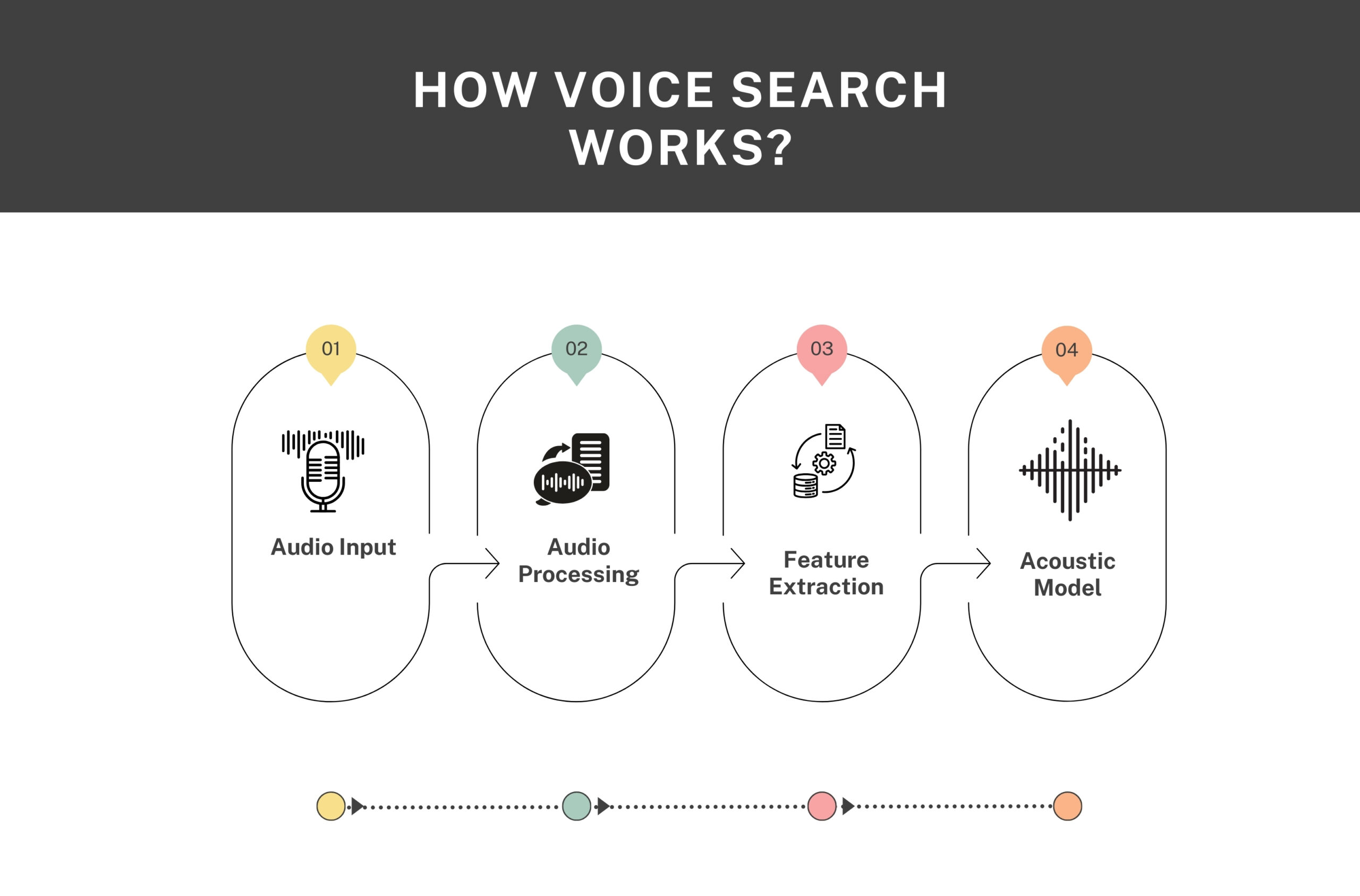
    How Voice Search Works?

    Voice search uses speech recognition technology to convert spoken language into text. Here’s a simplified overview of how it works:

    1. Audio Input: When you speak into a device, such as a smartphone or smart speaker, your voice is captured as an audio signal.
    1. Audio Processing: The audio signal is then pre-processed to remove background noise, normalize volume, and enhance the clarity of the speech.
    1. Feature Extraction: The processed audio is analyzed to extract relevant features, such as frequency patterns and spectral information, which are unique to different spoken sounds.
    1. Acoustic Model: These extracted features are compared to a vast database known as an acoustic model. This model contains patterns for different phonemes, syllabi, and words in various languages.
    1. Speech Recognition: The acoustic model predicts the most likely sequence of phonemes or words that match the input features. This is essentially the transcription of the spoken words into text.
    1. Language Model: The recognized text is then passed to a language model, which helps predict the most likely words and phrases based on the context of the sentence. This improves accuracy, especially in cases of ambiguous or unclear speech.
    1. Candidate Phrases: The system generates a list of possible phrases or sentences that could match the spoken input, along with their respective probabilities.
    1. Ranking and Selection: The system ranks the candidate phrases by probability and selects the most likely one. This is the final output of the voice search process.


    How Voice Search Works

    The Technical Aspect of Voice Search SEO

    While content remains paramount, the technical aspects of your website also play a crucial role. Page speed, mobile-friendliness, and structured data markup are essential factors that influence voice search SEO. Mobile optimization is especially important since most voice searches are conducted on smartphones. 

    Moreover, structuring your content with headers and subheadings can make it more scannable and understandable for search engines. Remember, virtual assistants are looking for clear, concise answers, so organizing your content logically can increase the chances of your information being selected for voice responses.


    The Road Ahead

    As technology continues to evolve, voice search is poised to become even more integral to our daily lives. Voice-activated devices are becoming smarter and more sophisticated, allowing for more natural and nuanced interactions. Consequently, voice search SEO will continue to evolve, demanding a dynamic and adaptive approach.

    Content creators and businesses must stay attuned to emerging trends and changing user behaviors. Regularly updating and refreshing content to match evolving voice search patterns is crucial. Additionally, voice commerce, where users make purchases through voice commands, is an emerging field that offers exciting possibilities for businesses to explore.


    Conclusion

    Voice search SEO is not just a trend; it’s a prototype that demands a fresh perspective on content creation and optimization. With users relying on voice-activated devices for quick and accurate information, businesses that adapt their SEO strategies to accommodate this shift will undoubtedly stay ahead of the curve. 

    By creating conversational, context-rich, and locally optimized content, while also attending to technical SEO aspects, businesses and content creators can position themselves for success in this new era of search. The journey towards mastering voice search SEO may be challenging, but it’s a journey worth undertaking to unlock the full potential of this transformative technology.


    Frequently Asked Questions (FAQs)

    [/vc_column_text][vc_toggle title=”What are some best practices for voice search optimization?” css=””]Best practices include creating conversational content, using natural language, targeting long-tail keywords, optimizing for mobile, and providing concise, direct answers to common questions.[/vc_toggle][vc_toggle title=”Why is Voice search optimization important?” css=””]Voice search is becoming increasingly popular, and optimizing for it ensures your content is discoverable to users who prefer hands-free search methods, potentially increasing your website’s traffic and engagement.[/vc_toggle][vc_toggle title=”What is voice search optimization?” css=””]Voice search optimization involves optimizing your website or content to make it more accessible and relevant to users who perform searches using voice-activated devices or voice assistants like Siri, Google Assistant, or Alexa.[/vc_toggle][vc_toggle title=”What are the emerging trends in voice search optimization?” css=””]Emerging trends include the integration of voice search in smart home devices, improvements in natural language processing, and more personalized voice responses based on user preferences.[/vc_toggle][vc_toggle title=”Is voice search optimization suitable for all types of businesses?” css=””]Voice search optimization can benefit a wide range of businesses, but its relevance may vary depending on the industry and target audience. Businesses with local or informational content can particularly benefit.[/vc_toggle][vc_toggle title=”Can voice search optimization benefit e-commerce businesses?” css=””]E-commerce sites can optimize product listings, provide concise product descriptions, and use schema markup to enhance their chances of being recommended in voice search results.[/vc_toggle][/vc_column][/vc_row]

  • Off-Page SEO Techniques that Boosts Your Website’s Authority

    There are two types of SEO: On-Page and Off-Page SEO. But first, let’s understand what SEO is. Search Engine Optimization (SEO) refers to the practice of optimizing websites and content to rank higher in organic search results, making them more likely to be found by people searching for relevant information, products, or services.


    On-page SEO refers to the optimization activities carried out directly on the website’s web page or content whereas, Off-Page SEO focuses on activities that take place outside of the website itself.


    In this article, we will help you understand how Off-Page SEO techniques can help you enhance your website’s authority.


    Creating High-Quality Backlinks


    Off Page SEO


    Creating backlinks is one of the most effective factors in Off-Page SEO and in increasing your website’s authority. Backlinks are the links from external websites that point to your site. Data shows that Google is much more likely to rank a website better than another if one domain has more backlinks.


    Focus on acquiring high-quality backlinks from reputable and relevant sources within your niche. These links will bring major traffic to your website which will help Google to recognize it as a trustworthy, dependable source of information. 


    Even though link building is hard and requires a long-term strategy, if done effectively, your website’s average ranking position in search results is very likely to increase.


    Influencer Marketing


    Influencer marketing is a strategy where brands collaborate with individuals who have a large following and who are active on social media, to promote products, services, or brands. You have to reach out to those influencers and ask them if they are interested in collaborating with your company.


    These influencers have a large audience and can help you boost your website’s credibility and traffic. Influencer marketing is a very useful Off-Page SEO technique.


    Social Media Management


    One of the most effective Off-Page SEO techniques is Social Media. Social media is a great way to increase your website’s traffic and can help you establish brand authority. Sharing your content, interacting with your audience, and building a strong social media presence can increase your brand’s visibility and drive more traffic to your website. 


    Although social media platforms will not directly benefit from your SEO, social signals such as likes, shares, and comments, can indirectly influence your website’s rankings.


    Content Marketing


    Creating high-quality, informative, and shareable content is a fundamental off-page SEO technique. When your content is engaging and valuable, it’s more likely to be shared on social media and other websites. Content marketing helps businesses attract and engage customers online. 


    This organic sharing can lead to natural backlinks and increased authority. Content marketing can improve your website’s rankings in search engines like Google. 


    Guest Posting


    One of the effective ways to market your content is by writing guest posts, This will not only help you build quality backlinks but also trigger more organic traffic to your website.


    Guest posting is an effective way to build backlinks and increase your website’s authority. By contributing high-quality, relevant content to other reputable websites in your industry, you can showcase your expertise and earn valuable backlinks.


    Ensure that your guest posts provide value to the readers and include a link back to your website within the author bio or content when relevant.


    Local SEO and Google My Business


    Local SEO is the process of optimizing your online presence to increase your visibility in local search results and brand awareness. It is an important Off-Page SEO technique and can significantly boost your website’s authority, especially for local or regional audiences. Strategies like local link building can improve your online presence within specific geographical areas, which can be crucial for attracting local customers.


    Google My Business helps you influence how your business shows up in Google. Ensure that your business profile is complete and accurate with essential information and encourage customers to leave reviews.


    Online Reputation and Management


    Monitoring what people are saying about your brand actively and responding to customer reviews, both positive and negative builds customer trust. Studies show that a maximum number of buyers purchase products after reading the reviews. 


    Manage your brand’s online presence by addressing customer feedback and maintaining a positive image. A strong online reputation can attract more visitors and enhance your website’s credibility.


    Conclusion


    By implementing these strategies, such as building high-quality backlinks, engaging in content marketing, and social media management, you can enhance your website’s credibility, attract more visitors, and ultimately achieve online success. Keep in mind that Off-page SEO is an ongoing process that requires dedication and consistent effort, so stay committed.


    Hope this article’s information will help you!


    Frequently Asked Questions (FAQs)


    1. What is the role of content marketing in off-page SEO?

    Content marketing involves creating valuable content. When your content is engaging and informative, it’s more likely to be shared on other websites and social media platforms, which can lead to natural backlinks and increased website authority.


    1. How can I build high-quality backlinks for my website?

    To build high-quality backlinks, focus on creating valuable content, guest posting on reputable websites, reaching out to influencers, and networking within your industry. Quality backlinks from authoritative sites are more valuable than quantity. 


    1. How can I measure the success of my off-page SEO efforts?

    You can measure the success of your off-page SEO efforts by using tools like Google Analytics and SEO analytics platforms. Track metrics such as website traffic, search engine rankings, and the number of backlinks. Analyze the data to refine your strategies.


    1. How do I manage my online reputation for better website authority?

    To manage your online reputation, actively monitor and respond to customer reviews and feedback. Maintain a positive image by addressing issues promptly and professionally. A strong online reputation can enhance your website’s credibility.