Blog

  • Local Seo tips that will increase your revenue in 2025

    In today’s digital age, having a strong online presence is essential for any business that wants to succeed, especially when it comes to targeting local customers. In this blog post, we’ll discuss the benefits of Local SEO, and some tips and strategies for optimizing your business’s online presence for local search. So whether you’re a small business owner looking to attract more local customers or a marketer trying to help your clients improve their local SEO, keep reading to learn more!

    What is Local SEO?

    Local SEO (Search Engine Optimization) is the practice of optimizing a website or online presence to improve its visibility in local search results. Local search results are those that appear when a user searches for a product, service, or information in a specific geographical location.

    The goal of local SEO is to increase the visibility of a business in local search results, particularly in the Google “Local Pack” or “Maps Pack,” which shows the top three local results. This can be achieved through a variety of strategies, including optimizing the website for local keywords, building local citations (mentions of the business name, address, and phone number on other websites), and optimizing the Google My Business profile.

    Local SEO is essential for businesses that depend on nearby customers, such as restaurants, retail stores, and service providers.By improving their local search rankings, businesses can increase their visibility to potential customers, drive more website traffic, and ultimately increase sales and revenue.

    Benefits of Local SEO

    1- Increased Online Visibility: Local SEO helps your business appear in search engine results when potential customers search for products or services in your area. 

    2- Targeted Traffic: Local SEO targets people who are actively looking for products or services in your area. By optimizing your website for local search, you can attract highly targeted traffic to your website.

    3- Improved User Experience: Local SEO helps you provide a better user experience for your website visitors. By providing accurate information about your business, such as your address, phone number, and hours of operation, you can help potential customers find the information they need quickly and easily.

    4- Higher Conversion Rates: When people search for products or services in their local area, they are more likely to make a purchase. By appearing in local search results, you can increase your chances of converting website visitors into customers.

    5- Cost-Effective Marketing: Local SEO is a cost-effective way to promote your business online. By optimizing your website for local search, you can attract highly targeted traffic without spending a lot of money on advertising.

    6- Competitive Advantage: Local SEO can give your business a competitive advantage over other businesses in your area. By appearing at the top of local search results, you can establish your business as a trusted and authoritative source of information in your industry.

    In summary, local SEO is an essential marketing strategy for businesses that want to attract more customers and increase their online visibility. It can help you reach a larger audience, generate more leads, and provide a better user experience for your website visitors.

    How to Optimize Your Website for Local SEO

    Here are some of the best tips to optimize your website for local SEO:

    1- Include your location on your website: Make sure your website includes your business’s physical address, phone number, and email address, preferably in the footer or on the contact page.

    2- Create and optimize your Google My Business listing: Google My Business is a free tool that helps businesses manage their online presence on Google. Fill out your business information accurately and completely, including your business name, address, phone number, website, and business hours. Use high-quality images of your business and add relevant categories.

    3- Get listed in local directories: Submit your business to local directories like Yelp, Yellow Pages, and other niche directories that are relevant to your industry.

    4- Use location-specific keywords: Incorporate location-specific keywords into your website’s content, title tags, meta descriptions, and URL. Use Google’s Keyword Planner tool to identify relevant keywords for your website.

    5- Create location-based landing pages: If your business has multiple locations, create individual landing pages for each location. Include unique content and location-specific information on each page.

    6- Get customer reviews: Encourage customers to leave reviews on your Google My Business listing and other relevant review sites. Respond to reviews promptly and professionally.

    7- Use structured data markup: Use structured data markup to help search engines better understand your business and its location.

    8- Optimize your website for mobile: Make sure your website is optimized for mobile devices. More than half of all online searches are done on mobile devices, and Google prioritizes mobile-friendly websites.

    9- Use schema markup: Use schema markup to help search engines understand your website’s content. Schema markup can include information such as your business name, address, phone number, and reviews, making it easier for search engines to display this information in search results.

    10- Monitor and respond to reviews: Monitor your online reviews and respond to them promptly, whether they are positive or negative. This shows that you value your customers and are committed to providing the best service possible.

    11- Create local content: Create blog posts or other content that is relevant to your local community. Include local events, news, and other topics of interest to your local audience.

    By implementing these local SEO strategies, you can improve your website’s visibility and increase traffic from local search queries.

    Tips for Improving Your Local SEO Rankings

    Here are some simple tips to help you improve your local SEO rankings:

    1- Claim and optimize your Google My Business (GMB) listing: Make sure your GMB listing is complete with accurate and consistent information about your business, such as your business name, address, phone number, and website. Also, make sure to include relevant categories and high-quality photos.

    2- Ensure consistent NAP information: Ensure that your Name, Address, and Phone number (NAP) information is consistent across all your online listings, including your website, social media, and directories.

    3- Get listed in local directories: List your business in local directories such as Yelp, Yellow Pages, and local Chamber of Commerce websites. This helps to increase your visibility and credibility in your local community.

    4- Get customer reviews: Encourage your customers to leave reviews on your GMB listing and other review sites. Positive reviews can improve your rankings and attract new customers.

    5- Use local keywords: Include local keywords in your website content, meta descriptions, and title tags.

    6- Use schema markup: Add schema markup to your website to provide search engines with additional information about your business, such as your hours of operation, services, and customer reviews.

    7- Create local content: Create content that is relevant to your local audience, such as blog posts, infographics, and videos that highlight local events or attractions.

    8- Use social media: Use social media to engage with your local community, share relevant content, and promote your business.

    By implementing these tips, you can improve your local SEO rankings and attract more local customers to your business.

    Conclusion

    Local SEO is a critical strategy for businesses looking to increase their online visibility and reach potential customers in their local area. By optimizing their website, Google My Business profile, and other online listings, businesses can improve their rankings in local search results and attract more local customers.

    Some key takeaways from local SEO include:

    1- Consistency is key: Businesses should ensure that their name, address, and phone number (NAP) are consistent across all online listings and directories.

    2- Google My Business is essential: A complete and accurate Google My Business profile is crucial for ranking well in local search results.

    3- On-page optimization matters: Businesses should optimize their website content, titles, descriptions, and meta tags to include relevant keywords and location information.

    4- Local backlinks are valuable: Building backlinks from other local websites and directories can help improve a business’s local search rankings.

    5- Reviews are important: Positive reviews on Google and other online platforms can boost a business’s local SEO efforts and attract more customers.

    Overall, local SEO is an ongoing process that requires time and effort, but the benefits can be significant for businesses looking to attract more customers in their local area.

    Q- What is Local SEO?

    Ans- Local SEO (Search Engine Optimization) is the practice of optimizing a website to increase its visibility and ranking on search engines for local search queries.

    Q- What is SEO?

    Ans- Search Engine Optimization (SEO) is a set of practices that focus on optimizing your website for search engines, allowing you to increase your visibility and rankings in search engine results pages.

    Q- What are the benefits of local SEO?

    Ans- It allows you to reach more of the local audience. With local SEO, there’s a decrease in the competition since you’re only competing against other businesses serving the same area rather than larger companies from across the country.

    Q- What needs to be done for local SEO?

    Ans- It can be done by creating high-quality content that is relevant to local shoppers and utilizing local citations across several authoritative directories, such as Google My Business.

    Q- What tools do I need for local SEO?

    Ans- Tools like Google My Business and Bing Places help ensure that your business information is easy to find and accurate everywhere it appears online. Google Analytics helps you measure the performance of your website content so you can make changes where needed. 

    Q- What tactics need to be used for local SEO?

    Ans- Tactics like including location-specific keywords, optimizing your listings on local search directories, and ensuring that your website is optimized for local searches should all be part of the game plan. 

    Q- What aspects of my website need improvements for Local SEO?

    Ans- Firstly, it’s important to ensure that your site is properly indexed and structured. Also, look into building up your business name, address, and phone number (NAP), as well as tracking keyword performance, and creating content relevant to your set geographic targeting radius.

  • How Influencer Marketing is the #1 trend on Social Media

    In recent years, influencer marketing has emerged as a popular and effective strategy for brands to connect with their target audience and promote their products or services. In this blog, we will explore the benefits of influencer marketing, how to find the right influencers, how to measure the success of influencer marketing, and tips for getting started with influencer marketing. 

    What is Influencer Marketing?

    Influencer marketing is a type of marketing that involves partnering with individuals who have a large social media following and are considered to be experts in their respective niches or industries, in order to promote a brand, product, or service.

    These individuals often referred to as “influencers“, have a significant impact on the purchasing decisions of their followers and can help increase a brand’s visibility, reach, and engagement through their posts, videos, stories, or other forms of content.

    Influencer marketing campaigns can take many forms, such as sponsored posts, product reviews, brand ambassadorship, social media takeovers, and more. The effectiveness of influencer marketing depends on the fit between the influencer, the brand, and the target audience, as well as the authenticity and transparency of the partnership.

    Benefits of Influencer Marketing

    There are several benefits of influencer marketing, including:

    1- Increased brand awareness: Working with influencers can help expand your brand’s reach and exposure to their large and engaged social media following.

    2- Improved trust and credibility: Influencers are often seen as trusted experts in their niches, and partnering with them can enhance your brand’s credibility and reputation.

    3- Higher engagement rates: Influencer marketing can result in higher engagement rates, as followers are more likely to engage with content from influencers they trust and follow closely.

    4- More targeted advertising: Influencers often have a specific niche or demographic they cater to, which can help you reach a more targeted audience with your advertising.

    5- Better return on investment: Influencer marketing can be more cost-effective than traditional advertising methods, as it often requires less investment and can lead to more impactful results.

    6- Increased conversions: Influencer marketing can lead to higher conversion rates, as followers of influencers may be more likely to make a purchase if the influencer recommends a product or service.

    How to Find the Right Influencers

    Finding the right influencers for your brand can be a critical step in running a successful influencer marketing campaign. Here are some steps to help you find the right influencers:

    1- Define your target audience: Before you start looking for influencers, make sure you have a clear understanding of your target audience. This will help you find influencers who can connect with your audience and promote your brand effectively.

    2- Use social media tools: There are several social media tools that can help you find influencers in your niche. These tools can help you search for influencers based on criteria like followers, engagement rate, niche, and location.

    3- Check hashtags: Hashtags related to your industry or product can be a great way to find influencers who are already talking about your niche.

    4- Look for user-generated content: Look for user-generated content that is related to your brand or industry. Often, users who create this type of content can become excellent influencers for your brand.

    5- Check engagement rates: When you find potential influencers, be sure to check their engagement rates to ensure they have an engaged and active following.

    6- Review content quality: Make sure to review the content of potential influencers to ensure their style and quality align with your brand image.

    7- Consider audience demographics: Make sure to check the demographics of an influencer’s audience to ensure that it aligns with your target audience.

    8- Reach out and start a conversation: Once you have identified potential influencers, reach out and start a conversation to gauge their interest in collaborating with your brand.

    How to Measure the Success of Influencer Marketing

    Measuring the success of influencer marketing can be challenging, but there are several key metrics that can help you evaluate the effectiveness of your campaign. Here are some ways to measure the success of your influencer marketing campaign:

    1- Reach and Impressions: One of the most critical metrics for measuring the success of an influencer campaign is reach and impressions. This includes the number of followers an influencer has and the number of people who saw your brand’s content through the influencer’s post.

    2- Engagement: Another important metric is engagement, which refers to the number of likes, comments, shares, and other interactions on a post. This metric can help you determine the level of interest and engagement your brand’s content generated.

    3- Conversions: The ultimate goal of influencer marketing is to increase conversions, whether that’s sales, sign-ups, or other actions. Measuring the number of conversions generated by your influencer campaign can help you determine the ROI of your investment.

    4- Brand awareness: Another key metric for measuring the success of an influencer campaign is brand awareness. You can measure brand awareness by tracking the number of mentions, shares, or hashtags related to your brand.

    5- Influencer impact: It’s important to evaluate the impact of the influencer on your campaign. This includes factors like how many people were driven to your website or social media profiles through the influencer’s posts.

    6- Cost-per-engagement: Calculating the cost-per-engagement of an influencer campaign can help you determine the effectiveness of your investment.

    Overall, measuring the success of influencer marketing requires a combination of quantitative and qualitative metrics. It’s important to establish clear goals for your campaign and use data-driven insights to evaluate its effectiveness.

    Tips for Getting Started with Influencer Marketing

    In recent years, influencer marketing has emerged as a popular and effective strategy for brands to connect with their target audience and promote their products or services. By partnering with social media influencers who have a large and engaged following, brands can leverage their reach and credibility to reach new customers and build brand awareness.

    1- Define your goals: Start by defining your goals for your influencer marketing campaign. Do you want to increase brand awareness, boost sales, or build credibility? Having clear goals will help you determine the best approach to finding and partnering with influencers.

    2- Identify your target audience: Determine who your target audience is, and then research the influencers who cater to that audience. This will help you find influencers who have the right followers and engagement to reach your target audience.

    3- Choose the right influencers: Not all influencers are the same, so take the time to find the right ones for your brand. Consider factors such as the influencer’s audience, engagement rate, content style, and reputation.

    4- Develop a partnership: Once you’ve identified potential influencers, reach out and start a conversation to discuss a potential partnership. Make sure to outline your expectations, such as the type of content you want the influencer to create, and agree on compensation.

    5- Create a content strategy: Develop a content strategy that outlines the type of content you want the influencer to create, as well as the messaging and branding guidelines. Make sure to give the influencer creative freedom while ensuring the content aligns with your brand.

    6- Track and measure results: Track and measure the results of your influencer marketing campaign to evaluate its success. Use tools like Google Analytics and social media analytics to monitor the impact of the campaign on your website traffic, engagement rates, and conversions.

    7- Be transparent: Make sure to be transparent about your partnership with the influencer. Clearly label any sponsored content as such to maintain transparency and build trust with your audience.

    Conclusion

    In conclusion, influencer marketing can be a highly effective strategy for brands to connect with their target audience, increase brand awareness, and drive conversions. By partnering with the right influencers, brands can leverage their audience and credibility to reach new customers and build trust with their existing ones. To succeed in influencer marketing, it’s important to set clear goals, find the right influencers, develop a content strategy, track and measure results, and maintain transparency with your audience. While influencer marketing can be a complex and ever-changing field, by following best practices and staying up-to-date with trends and developments, brands can unlock their potential to achieve their marketing objectives.

    Q- What is influencer marketing?

    Ans- Influencer marketing is a type of marketing that involves partnering with individuals who have a large social media following and are considered to be experts in their respective niches or industries, in order to promote a brand, product, or service.

    Q- What are some benefits of using influencers?

    Ans-  Benefits include higher levels of brand awareness, increased sales, and leads, greater customer engagement and loyalty, and access to multiple networking opportunities, which can open up whole new markets. 

    Q- How can you identify an influencer?

    Ans- They tend to have a good following on social media, their profiles should feature an impressive list of collaborations or endorsements from other brands or individuals, and the influencer’s writing style and messaging need to stand out from the crowd in order for them to have real influence.

    Q- What is the process of collaborating with an influencer?

    Ans- You need to identify which influencers align with your brand, reach out to them by email or private message on social media, and then you’ll have to provide detailed information about your project, including, why you think they’d be a good fit for it, what they’d get in return, metrics they’ll be able to track their success with, etc. 

    Q- How do you measure the success of your influencer marketing initiative?

    Ans- Measuring the success of influencer marketing requires a combination of quantitative and qualitative metrics. It’s important to establish clear goals for your campaign and use data-driven insights to evaluate its effectiveness.

  • Start making more money with Google AdWords!

    In the world of digital marketing, Google AdWords has become an essential tool for businesses looking to reach a larger audience and drive more traffic to their website.

    In this blog, we will take a closer look at the benefits of Google AdWords and how businesses can use this platform to drive more traffic, generate leads, and increase conversions. So let’s dive in and discover how Google AdWords can help your business succeed in the digital age.

    What is Google AdWords? 

    Google AdWords is Google’s online advertising platform, which businesses of all sizes can use to advertise their products or services in the most cost-effective way. It is a complex system of multiple components that helps businesses target potential customers with relevant ads when they search for appropriate keywords, both online and on mobile devices.

    Businesses create campaigns using its simple interface by selecting relevant keywords, establishing a budget, and writing ad copy; these ads should then begin to appear on relevant sites such as Google, YouTube, and any other websites that are part of Google’s ad network. 

    Benefits of Google AdWords

    Google AdWords, now known as Google Ads, is an online advertising platform developed by Google that allows businesses to display their ads on Google’s search engine results pages and other websites within the Google Ad Network. Here are some benefits of using Google AdWords for your business:

    1- Targeted advertising: Google Ads allows you to target specific geographic locations, languages, devices, and demographics so that your ads are shown to the right audience.

    2- Measurable results: Google Ads provides comprehensive reporting and analysis tools that enable you to measure the effectiveness of your ad campaigns and adjust them accordingly.

    3- Cost-effective: Google Ads is a pay-per-click (PPC) advertising model, which means that you only pay when someone clicks on your ad. You can set a budget for your ad campaigns and control your advertising costs.

    4- High visibility: With Google Ads, your ads can appear at the top of the search results page, which can significantly increase your visibility and reach.

    5- Quick results: Google Ads can start generating traffic to your website within minutes of setting up your account.

    6- Flexibility: You can create and modify your ad campaigns in real time, allowing you to quickly adjust your advertising strategy to suit your business needs.

    7- Competitive advantage: Using Google Ads can give you a competitive advantage over businesses that rely solely on organic search results to generate traffic and leads.

    Overall, Google Ads can be a powerful tool for businesses of all sizes to increase their online visibility, attract new customers, and grow their business.

    How to set up a Google AdWords Campaign 

    Remember that creating a successful Google AdWords campaign requires ongoing optimization, testing, and refinement. It’s important to regularly review your data and make adjustments to your keywords, bids, and ad copy to improve your ad performance over time.

    Here are the general steps to setting up a Google AdWords campaign:

    1- Sign in to your Google Ads account or create one if you don’t have one yet.

    2- Click on the “Campaigns” tab and then click the “+” button to create a new campaign.

    3- Select your campaign goal, such as website traffic, leads, sales, etc. 

    4- Give your campaign a name, select the geographic location where you want to target your ads and set your daily budget.

    5- Choose your bidding strategy, which determines how much you pay for your ads. You can select manual or automated bidding, depending on your goals.

    6- Create your ad group by selecting your keywords, setting your bids, and writing your ad copy.

    7- Create your ads by selecting the ad format, adding your ad text, and adding any relevant images or videos.

    8- Review your campaign settings, ad group settings, and ad settings to ensure that everything is correct.

    9- Save and launch your campaign. Google Ads will review your ads to ensure that they comply with their policies before they go live.

    10- Monitor your campaign regularly and make adjustments as needed to improve performance.

    Tips for optimizing your Google Ads Campaign 

    1- Define Your Target Audience: Clearly define your target audience by demographics, interests, location, and keywords, so that your ads only appear to people who are most likely to be interested in your product or service.

    2- Choose the Right Keywords: Research and choose keywords that are relevant to your business and have a high search volume. Use long-tail keywords and negative keywords to refine your targeting and avoid irrelevant clicks.

    3- Write Compelling Ad Copy: Write an ad copy that highlights the benefits of your product or service and includes a clear call to action. Use ad extensions, such as sitelinks and callouts, to provide more information and increase click-through rates.

    4- Set a Realistic Budget: Determine how much you are willing to spend on your AdWords campaign and allocate your budget accordingly. Monitor your spending and adjust your bids and budget as needed to ensure a positive return on investment.

    5- Use Geographic Targeting: Use geographic targeting to show your ads to people in specific locations. This can be particularly useful for businesses that only serve certain regions.

    6- Monitor and Optimize Your Campaign: Regularly monitor your campaign performance and make adjustments as needed. Test different ad variations, landing pages, and targeting options to improve your results.

    7- Use Conversion Tracking: Set up conversion tracking to measure the effectiveness of your campaigns. This will help you identify which ads and keywords are generating the most leads or sales and optimize your campaigns accordingly.

    8- Consider Ad Scheduling: Consider setting up ad scheduling to show your ads at specific times of day or days of the week. This can help you maximize your budget and target your audience more effectively.

    9- Utilize Remarketing: Use remarketing to show ads to people who have already visited your website. This can help increase brand awareness and encourage people to return to your site and complete a purchase.

    10- Stay Up-to-Date with Google AdWords: Keep up-to-date with the latest features and updates in Google AdWords to ensure that you are taking advantage of all available opportunities to optimize your campaigns.

    How you should Measure the success of your Google AdWords Campaign

    Measuring the success of your Google AdWords campaign is essential to understanding its effectiveness and optimizing your future advertising efforts. Here are some key metrics to consider:

    1- Click-through Rate (CTR): CTR measures the percentage of people who click on your ad after seeing it. A higher CTR indicates that your ad is relevant to your target audience.

    2- Conversion Rate: The conversion rate measures the percentage of people who take the desired action, such as making a purchase or filling out a form, after clicking on your ad. A higher conversion rate indicates that your ad is effectively reaching your target audience.

    3- Cost-per-click (CPC): CPC is the amount you pay each time someone clicks on your ad. A lower CPC indicates that you are getting more clicks for your budget.

    4- Return on Investment (ROI): ROI measures the profitability of your advertising campaign by comparing the amount you spent on advertising to the revenue generated by the campaign. A positive ROI indicates that your advertising campaign is profitable.

    5- Quality Score: Quality Score is a metric used by Google to evaluate the relevance and quality of your ads and landing pages. A higher quality score indicates that your ads are more relevant to your target audience, resulting in a lower CPC and a higher ad position.

    6- Impressions: Impressions measure the number of times your ad appears in search results or on websites. A higher number of impressions indicates that your ad is reaching a large audience.

    By tracking and analyzing these metrics, you can gain insights into the effectiveness of your Google AdWords campaign and make data-driven decisions to improve your results.

    Conclusion

    The benefit of AdWords lies in its ability to be extremely targeted, where a business can make sure that their ads are only seen by the people they want to see them while also being able to measure the number of clicks each ad receives.

    Q- Are Google ads beneficial?

    Ans- Google Ads can be a powerful tool for businesses of all sizes to increase their online visibility, attract new customers, and grow their business.

    Q- What are some effective targeting options?

    Ans- Different targeting options vary in their effectiveness depending on the business’s goals. Commonly effective targeting options include geographic, demographic, psychographic, and behavioral targeting.

    Q- Can I place my ads on websites outside of Google search results?

    Ans- Yes, The internet is full of potential resources for alternative advertising, from social media to blogging sites and more. 

    Q- Is there a limit to how many ads I can place on a single page or site?

    Ans- As such, the number of ads per page should be carefully considered, with only a few ads being placed on each page. Ads should also be placed strategically, spaced apart from non-advertising content, and with the aim of making it eye-catching and captivating enough to draw in viewers.

    Q- Can I change my ad text or artwork after it’s been submitted to Google?

    Ans- It is possible to not only modify an ad’s text and artwork after it has been submitted but also to leverage a number of strategies to maximize its potential for success.

  • Should you change your Marketing Tactics? Look at the tactics that experts suggest

    In today’s fast-paced and ever-changing business landscape, it can be challenging for small businesses to navigate the different Marketing Tactics available and choose the ones that are right for their needs. That’s why in this blog, we will explore the different marketing tactics that are available to small businesses and how they can be leveraged to drive results. By the end of this blog, you’ll have a better understanding of the different marketing tactics available and which ones are best suited to your small business.

    What do Marketing tactics mean?

    Marketing tactics refer to the various strategies and techniques that businesses use to promote their products or services and persuade potential customers to make a purchase. 

    Marketing tactics are important for any business, big or small, because they help businesses reach their target audience, attract new customers, and retain existing ones. 

    Benefits of choosing marketing tactics for small businesses

    Marketing tactics can be extremely helpful for small businesses for several reasons, from increasing brand awareness of the brand to reaching the final customer to generating leads and increasing sales. 

    1. Increasing brand awareness: Marketing tactics can help small businesses to reach a larger audience and increase brand awareness. By using tactics such as social media marketing, content marketing, and influencer marketing, small businesses can introduce their brand to potential customers and build a community around their products or services.
    2. Generating leads and sales: Marketing tactics such as paid advertising, email marketing, and referral marketing can help small businesses to generate leads and sales. By targeting a specific audience, small businesses can attract customers who are interested in their products or services and convert them into paying customers.
    3. Building customer relationships: Marketing tactics such as email marketing, social media marketing, and content marketing can help small businesses to build relationships with customers. By providing value and engaging with customers on a regular basis, small businesses can establish trust and loyalty, which can lead to repeat business and positive word-of-mouth.
    4. Staying competitive: Marketing tactics can help small businesses stay competitive in their industry. By promoting their products or services and highlighting their unique value proposition, small businesses can differentiate themselves from competitors and attract customers who are looking for a specific solution.
    5. Measuring results: Marketing tactics can be easily measured and optimized for better results. By using tools such as Google Analytics and social media analytics, small businesses can track their marketing efforts and make adjustments to improve their ROI.

    Different marketing tactics to implement in your business

    The best marketing tactic for a small business depends on various factors, such as the target audience, the budget, the industry, and the overall marketing goals. Here are some effective marketing tactics that are often suitable for small businesses:Marketing Tactics

    1. Content marketing: Content marketing is a marketing tactic that involves creating and sharing valuable, relevant, and consistent content to attract and retain a target audience. The goal of content marketing is to provide information that is useful, entertaining, or informative to potential customers, with the aim of building trust and loyalty and ultimately driving profitable customer action. This is a cost-effective way to build a brand and attract customers by creating and sharing valuable and engaging content on blogs, social media, or other channels.
    2. Social media marketing: Social media marketing is a marketing tactic that involves using social media platforms, such as Facebook, Twitter, Instagram, and LinkedIn, to promote a business and its products or services. Social media marketing can help businesses reach a larger audience, engage with potential customers, and build brand awareness. It’s relatively low-cost and can be used to build a community around the brand, promote products or services, and offer customer support.
    3. Referral marketing: Referral marketing is a marketing tactic that involves encouraging and incentivizing customers to refer their friends and family to a business. Referral marketing can be a powerful way for businesses to acquire new customers, as referrals tend to be more likely to convert and have a higher lifetime value. This is a powerful way to leverage the loyalty of existing customers by encouraging them to refer friends and family to the business in exchange for rewards or discounts. 
    4. Email marketing: Email marketing is a marketing tactic that involves sending commercial messages to a group of people via email. The goal of email marketing is to build relationships with customers, drive sales, and increase brand awareness. Email marketing can be an effective and cost-efficient way for businesses to reach a large audience and promote their products or services. This is a cost-effective way to stay in touch with customers and prospects by sending targeted and personalized emails.
    5. Local SEO: Local SEO (search engine optimization) is a strategy for optimizing a website to improve its visibility in local search results. It’s an essential marketing tactic for small businesses that want to attract customers in their local area. This is a way to optimize a small business’s website for local search queries, which can help it appear higher in search engine results for location-based searches. This can be an effective way to attract customers who are searching for nearby businesses.

    One of the best marketing tactics for small business to start their working

    Local SEO is one of the best marketing tactics to start your business, it basically focuses firstly on local areas to reach local customers first. 

    Local SEO (search engine optimization) is a strategy for optimizing a website to improve its visibility in local search results. It’s an essential marketing tactic for small businesses that want to attract customers in their local area. Here are some steps to improve local SEO for small businesses:

    1. Optimize your website for local search: Ensure that your website includes your business name, address, and phone number (NAP) in a prominent location, such as the footer or the header. You should also create a dedicated “Contact Us” page with your NAP information and a Google Maps embed.
    2. Claim and optimize your Google My Business (GMB) listing: This is a free tool that allows businesses to manage their online presence across Google, including search and maps. Claim your GMB listing and fill out all the details, including your business category, hours of operation, photos, and reviews. Ensure that your NAP information is consistent across your website and GMB listing.
    3. Get listed in local directories: Submit your business to local directories such as Yelp, the Yellow Pages, and other relevant directories. Check to see if your NAP information is accurate across all directories.
    4. Generate online reviews: Encourage your customers to leave reviews on your GMB listing, Yelp, and other relevant review sites. Positive reviews can help improve your local search rankings and attract new customers.
    5. Use local keywords: Include local keywords in your website content and meta tags. For example, if you’re a dentist in Delhi, include keywords such as “Delhi dentist” and “dental services in Delhi.”
    6. Create local content: Create content that is relevant to your local audience, such as blog posts, videos, and infographics. This can help to improve your local search rankings and engage your audience.

    It’s important to note that no single marketing tactic works for every business, so it’s best to experiment with different tactics and measure the results to find what works best for your small business.

    By implementing these strategies, small businesses can improve their local SEO and attract more customers in their local area. It’s important to regularly monitor your local search rankings and make adjustments as needed to stay competitive.

    Q- What are marketing tactics?

    Ans- Marketing tactics refer to the various strategies and techniques that businesses use to promote their products or services and persuade potential customers to make a purchase. 

    Q- What is the role of marketing tactics?

    Ans- The role of marketing tactics is to help businesses achieve their marketing objectives by executing specific actions or activities that promote their products or services. 

    Q- Are marketing tactics and strategy are same?

    Ans- No, marketing tactics and marketing strategy are not the same thing. Marketing tactics are specific actions or activities that are used to promote a business, product, or service. Marketing strategy, on the other hand, is the overall plan for achieving a business’s marketing objectives.

    Q- Example of marketing tactics.

    Ans- Examples of marketing tactics include social media marketing, email marketing, content marketing, referral marketing, and local SEO.

    Q- What is SEO in the context of marketing?

    Ans- SEO (search engine optimization) is a marketing tactic that involves optimizing a website and its content to increase its visibility and ranking on search engine results pages (SERPs). SEO aims to boost the quality and quantity of organic visitors to a website.

     Q- Are marketing tactics powerful for businesses?

    Ans- Marketing tactics can be a powerful tool for small businesses to reach their target audience, generate leads and sales, build customer relationships, and stay competitive in their industry.

  • Is email marketing a must-have tactic for startups?

    Email marketing is an efficient and cost-effective way to promote products, services, and ideas. In this blog, we will explore the basics of Email marketing, including its benefits, strategies, and best practices for building successful campaigns that engage and convert subscribers. Whether you’re a startup or a marketing professional, this guide will provide you with the insights and knowledge you need to create impactful email marketing campaigns that drive results.

    What does email marketing mean?

    Email marketing is a digital marketing strategy that involves sending promotional messages or advertisements to a group of people through email. It can be used to promote products or services, build brand awareness, or cultivate relationships with customers. Effective email marketing campaigns typically involve carefully crafted content, targeted audience segmentation, and strategic timing of emails to maximize open and click-through rates.

    Why do startups need email marketing to start?

    Email marketing can be particularly beneficial for startups because it is a cost-effective way to reach potential customers and build brand awareness. Some of the ways that email marketing can benefit startups include:

    1. Generating leads: Email marketing can help startups build their email subscriber list, which can then be used to target potential customers with promotional offers or other marketing messages.
    2. Building brand awareness: Consistent and targeted email communication can help establish a startup’s brand in the minds of potential customers, leading to increased brand recognition and loyalty.
    3. Driving sales: Email marketing campaigns can be used to promote products or services, with special offers or discounts that can drive sales.
    4. Nurturing relationships: Email marketing can help startups build relationships with their customers by providing them with relevant and useful content, fostering engagement and loyalty.
    5. Tracking and measuring results: Email marketing platforms provide detailed analytics that can be used to track and measure the success of email campaigns, allowing startups to refine their strategies and improve their results over time.

    Does email marketing help startups?

    Yes, email marketing can be a highly effective tool for startups. Email marketing allows startups to communicate directly with their target audience, build relationships, and promote their products or services. Here are some ways that email marketing can help startups:

    1. Cost-effective: Email marketing is relatively inexpensive compared to other forms of marketing, making it an affordable option for startups with limited budgets.
    2. Targeted: Startups can use email marketing to reach specific segments of their target audience based on factors like interests, behaviors, and demographics.
    3. Relationship building: Email marketing allows startups to build relationships with their subscribers over time by providing valuable content, such as educational resources, special offers, and news updates.
    4. Measurable: Startups can track the performance of their email marketing campaigns through metrics like open rates, click-through rates, and conversions. This data can help them refine their approach and improve their results over time.


    Best email marketing tactics for startups

    1. Build a targeted email list: Start by building an email list of people who are interested in your startup and what you offer.
    2. Segment your list: Segment your email list into smaller groups based on demographics, behavior, and interests. 
    3. Use a clear subject line: Use a subject line that clearly communicates what the email is about and entices the recipient to open it.
    4. Personalize your emails: Use the recipient’s name and other personalized details to make the email feel more personal and relevant.
    5. Provide value: Provide valuable content in your emails, such as tips, advice, or exclusive offers.
    6. Use a clear call to action: Include a clear and compelling call to action in your emails, such as signing up for a free trial or making a purchase.
    7. Test and optimize: Test different email elements, such as subject lines, content, and calls to action, and optimize based on the results to improve the effectiveness of your email campaigns.


    Popular tools of email marketing that every startup should know

    There are many email marketing tools that startups can use, but some popular options include Mailchimp, Constant Contact, ConvertKit, AWeber, and HubSpot. These tools offer various features like email automation, list management, A/B testing, and analytics to help startups grow their email lists, engage with their audience, and track their email marketing performance. Many of these tools offer free or low-cost plans for startups or small businesses.

    1. Mailchimp: Mailchimp is a web-based email marketing service that allows businesses and individuals to send marketing emails, automated messages, and targeted campaigns to their subscribers. It also offers tools for audience management, social media advertising, landing pages, and more.
    2. Constant Contact: Constant Contact is a web-based email marketing service that provides tools for businesses and organizations to create and send email campaigns, as well as manage their subscriber lists, track results, and analyze data. It also offers features such as event management, social media integration, and online surveys.
    3. CovertKit: ConvertKit is a cloud-based email marketing platform designed for bloggers, content creators, and small businesses. It offers features such as email automation, customizable opt-in forms, landing pages, and subscriber tagging to help users grow and manage their email lists.
    4. Hubspot: HubSpot is a cloud-based customer relationship management (CRM) software that offers a suite of tools for marketing, sales, customer service, and content management. Its features include email marketing, lead tracking, analytics, social media management, and automation. HubSpot aims to help businesses of all sizes attract, engage, and delight customers by providing an all-in-one solution for managing customer interactions and improving the customer experience.
    5. AWeber: AWeber is a cloud-based email marketing platform that enables businesses to create and send emails, manage subscribers, and track email campaign performance. Its features include customizable email templates, autoresponder sequences, landing pages, subscriber segmentation, and analytics. AWeber is designed for small businesses and entrepreneurs who want to build and maintain their email lists, engage with subscribers, and automate their email marketing campaigns.


    Wondering how to write emails to attract more customers?

    When writing an email, businesses should follow these best practices:

    1. Write a clear and concise subject line that summarizes the email’s purpose.
    2. Use a professional and personable tone in the email.
    3. Start with a greeting that addresses the recipient by name.
    4. Introduce the purpose of the email in the opening sentence or two.
    5. Use bullet points, subheadings, and short paragraphs to make the email easy to read.
    6. Keep the email focused on one topic or call to action.
    7. Provide a clear call to action and include any necessary links or attachments.
    8. End the email with a polite closing, such as “Best regards” or “Sincerely,” and include your contact information.
    9. By following these best practices, businesses can write effective emails that are easy to read and understand, and that effectively communicate their message to the recipient.


    Conclusion

    In conclusion, email marketing is a valuable tool for startups looking to establish and grow their business. It is a cost-effective and efficient way to reach a large audience, engage with customers, and promote products or services. By building a targeted email list, creating compelling content, and using email marketing automation, startups can generate leads, increase sales, and build brand loyalty. However, it is important to follow best practices, such as obtaining permission to email subscribers, personalizing content, and optimizing for mobile devices. With a well-planned email marketing strategy, startups can leverage the power of email to drive business success and growth.


    Q- What is email marketing?

    Ans- Email marketing is a digital marketing strategy that involves sending promotional messages or advertisements to a group of people through email. 

    Q- Why email marketing is done?

    Ans-  It can be used to promote products or services, build brand awareness, or cultivate relationships with customers.

    Q- What is the point of email marketing?

    Ans- The point of email marketing is to use email as a tool to promote products or services, build relationships with customers or subscribers, and drive conversions or sales.

    Q- Does email marketing help businesses to directly connect with customers?

    Ans- Yes, email marketing helps businesses to directly connect with customers by allowing them to send personalized messages and promotions directly to a subscriber’s email inbox. This form of direct communication can be used to build relationships with customers, provide updates, and encourage engagement. 

    Q- What is the right time to send emails to customers?

    Ans- The right time to send emails to customers can vary based on a variety of factors, including the industry, audience, and content of the email. However, some general best practices suggest that the ideal time to send emails is when the recipient is most likely to be checking their email, such as during the middle of the day on weekdays.

    Q- How often should you send emails to your subscribers?

    Ans- It is generally recommended to maintain a regular schedule to keep subscribers engaged without overwhelming them. This could be once a week, bi-weekly, or once a month, depending on the business and the preferences of the subscribers.

  • App Store Optimization: 12 Expert Hacks and Tools to Boost Your App Ranking

    [vc_row][vc_column][vc_column_text css=””]If you’re a small business owner, you know that getting your app onto the app store is essential for reaching a wider audience. But how do you get started? In this blog post, we’ll discuss the different factors that affect App Store Optimization and how you can use them to your best advantage. We’ll also provide tips on how to create a well-optimized app and ensure that it pops up when people search for your specific niche. 


    What does App Store Optimization mean?

    App store optimization is the process of increasing the visibility of a business’s app in order to get more searches in the app store, which allows a business to improve the quality of the app and increase traffic, generate leads, and increase sales.

    • This is a the process of improving the visibility of a mobile app in app stores.
    • It helps increase search appearances when users look for related apps.
    • Better visibility leads to- Higher app traffic, More user downloads, Improved lead generation, Increased app-based sales.
    • ASO also contributes to enhancing the app’s overall quality by aligning it with user needs and search behavior.


    Why is it necessary to optimize your app?

    It’s no secret that the number of mobile app downloads continues to grow at a staggering pace. In fact, according to eMarketer, by 2022, global app downloads will reach 36.9 billion! This is great news for businesses of all sizes, as it means that there is an ever-growing demand for mobile apps. However, in order to ensure that your app is found by potential customers and becomes a hit in the app store, you need to optimize it for download.

    How does ASO work?

    ASO usually involves spending the time to optimize each important aspect of your app’s listing. Although ASO is more often used in comparison to SEO, the process of optimizing your app for app stores is far simpler than optimizing for web searches. SEO is determined by hundreds of factors, whereas ASO can be reduced to a smaller number of components. Users of app stores use search queries to find different apps and games, and app stores can suggest apps based on the user’s preferences and popularity. Keyword optimization, search and paid ads, category rankings, and leading charts or apps featured in Google Play or the App Store are all obvious ASO strategies.

    Hacks for better App Store Optimization

    Here are the 12 best tips or hacks to make it possible for your app to improve or be prioritized in app store searches.

    1. Use High-Quality Keywords: Use relevant keywords only; don’t try to do keyword stuffing. 
    2. Write a Clear and Compelling App Description: Excellent work on your app description Add a short video to represent your app.
    3. Good Mobile uploading Speed: Your app should be mobile friendly, enhance the loading speed for better experience. 
    4. Use Eye-Catching App Icons: Use good designs and graphics to attract users. Graphics play an important role in optimizing your app, as they catch the attention of the users.
    5. Encourage Positive Reviews and Ratings: Add positive reviews; reviews are the major way in which users get satisfied enough to install an app.
    6. Attractive Title: Start with an informative and descriptive title.
    7. Choose the Right App Name: App names should be memorable and catchy so that users do not forget the name that will be printed in their minds.
    8. User Friendly App: Understand your users and post content regarding the likes of the audience, as it should be audience-friendly.
    9. Fix Bugs: Maintain the quality of your application; fix any bugs if they are there so that they will not bother users.
    10. Localize Your App for Global Reach: Localize your app to get more reach in different countries. It will help you promote your app globally.
    11. SEO:Use effective search engine optimization techniques for your app’s optimization.
    12. Customer Support: Increase user retention through top-quality customer support and a positive user experience.

    Strategies for App Store Optimization

    1. Keyword Research: Using the right keywords for your app will definitely help you get noticed.
    2. User Reviews & Ratings: Don’t use fake reviews; always aim to provide the best services to your users so that they can give real testimonials for your app.
    3. App Performance: Monitor the performance of your app.
    4. A/B Testing: Do A/B testing on your application.
    5. User Behavior: Understand the behavior of your users so that you can perform accordingly.

    Tools for App Store Optimization

    AppTweak: One of the best tools for app store optimization is App Tweak. It is used by well-known hosting companies such as Amazon and PayPal. It employs algorithms and a wide range of data to provide its customers with the most accurate insights possible.

    Sensor Tower: Sensor Tower is an app intelligence platform with a heavy emphasis on data. When it comes to any step of the mobile marketing funnel, data is our friend, and Sensor Tower really relies on data to help you make informed or best decisions about your app store optimization strategy.

    Split Metrics: Split Metrics is ideal for tracking user interactions on your app store page, from screenshot scroll rates to drop-off rates on promotional videos. This data gives you user behavior, particularly user behavior in relation to your brand or business, which can then be used to identify which aspects of your app store page to optimize most. 

    App Follow: App Follow is more than an app store optimization platform; it also has support capabilities and product management tools. App Follow has an extensive or exclusive range of app analytics tools with a specific dashboard that enables users to see download and revenue data for your application.

    FAQs

    [/vc_column_text][vc_toggle title=”What is app store optimization?” css=””]App store optimization is the process of increasing the visibility of a business’s app in order to get more searches in the app store, which allows a business to improve the quality of the app and increase traffic, generate leads, and increase sales.[/vc_toggle][vc_toggle title=”Why is it necessary to optimize the app store?” css=””]Optimizing your app is necessary as it boosts the profit using the income app, it increases the visibility of your app, and also increases organic traffic.[/vc_toggle][vc_toggle title=”What is Apptweak?” css=””]Apptweak is a tool of ASO that employs algorithms and a wide range of data to provide its customers with the most accurate insights possible.[/vc_toggle][vc_toggle title=”What is the acronym for ASO?” css=””]“App Store Optimization.”[/vc_toggle][vc_toggle title=”What are some of the most commonly used app store optimization tools?” css=””]Some of the most commonly used app store optimization tools are- Keyword Tool, Apptweak, Appfollow, Mobile action, Sensor Tower.[/vc_toggle][vc_toggle title=”How does app store optimization work?” css=””]When users of app stores use search queries to find different apps and games, app stores can suggest apps based on the user’s preferences and popularity.[/vc_toggle][vc_toggle title=”Is keyword research important for app store optimization?” css=””]Yes, keyword research is important to understand what users are searching for on SERPs related to your products and services.[/vc_toggle][vc_toggle title=”What is the functionality of the split metrics tool?” css=””]Split Metrics is ideal for tracking user interactions on your app store page, from screenshot scroll rates to drop-off rates on promotional videos. This data gives you user behavior, particularly user behavior in relation to your brand or business, which can then be used to identify which aspects of your app store page to optimize most.[/vc_toggle][/vc_column][/vc_row]

  • Beyond SEO: The New Rules of Search- Voice Search

    Discover the new rules of search beyond SEO. Learn about the importance of user experience, the rise of voice search, the impact of artificial intelligence, and what to expect in the future of search.

    Are you tired of traditional search engine optimization (SEO) tactics that no longer seem to work? If so, you’re not alone. As search engines continue to evolve, so do the rules of search. Today, it’s all about providing a user-centric experience that goes beyond SEO. From creating high-quality content to optimizing for voice search and building a strong brand presence, the new rules of search are all about putting the user first. So, if you’re ready to take your digital marketing strategy to the next level, read on to discover the exciting new possibilities beyond SEO.

    Introduction: The Evolution of Search-Voice Search

    Search engines have drastically evolved over the years, making it easier for individuals to retrieve information on the internet. In the early days, search engines were basic and didn’t have many advanced features. For instance, in 1990, Archie, the first search engine was created, which enabled individuals to search for specific files on FTP servers. However, Archie could only search for text files and wasn’t equipped to search the emerging world wide web.

    In the mid-’90s, Yahoo emerged with a more user-friendly search engine that utilized a web directory for organizing websites. Yahoo had the capability of browsing web pages instead of just searching for text files. 

    In the late ‘90s, Google sparked a revolution in search engines. Unlike its predecessors, Google’s PageRank algorithm evaluated web pages based on links to other pages, making it possible for Google to rank pages according to their relevancy to the search query. With its faster and more accurate search results, Google quickly dominated the search engine market, leading to the downfall of AltaVista, Excite, and other search engines that were once big players. The evolution of search engines has brought about a great transformation in the way that individuals interact with the internet, enabling people to navigate and locate information quickly and easily.

    The Importance of User Experience- New Search Rule

    User experience has become the new rule of search nowadays. A website with a poor user experience can cause visitors to quickly click away, which can result in lost sales, low customer retention, and a lack of trust from users. On the other hand, a well-designed website with a positive user experience can lead to increased engagement, higher conversions, and increased customer satisfaction. With the increasing importance of user experience, businesses must prioritize it in their online strategies to succeed in today’s competitive market.

    Aside from improving customer satisfaction and driving more conversions, a good user experience can also benefit a business in terms of its search engine rankings. Search engines like Google algorithmically rank websites based on various factors, including user experience. Websites that offer a seamless and positive user experience tend to rank higher on SERP, meaning that businesses can gain increased visibility and traffic by investing in a good user experience.

    The Rise of Voice Search– New Search Rule

    With the advancements in technology, there has been a rapid increase in the use of voice search. Voice search involves conducting a search query by speaking to a device rather than typing it manually. The rise of voice search is backed by the fact that it is more convenient, efficient, and time-saving, especially for people on the go or with disabilities. With the emergence of smart home devices like Amazon Echo and Google Home, people are finding it easier to use voice search for various tasks, including controlling their devices or ordering food from their favorite restaurants. 

    SEO New Feature Voice SearchVoice search is poised to play a significant role in the future of search engines. Search engines will need to evolve to accommodate voice search requests and user behavior, which can entail updating algorithms, search result pages, and other aspects of their platforms. For marketers, understanding the intricacies of voice search and optimizing their website’s content for voice search will be crucial in ensuring they remain competitive in the digital landscape. 
    The Impact of Artificial Intelligence- New Search Rule

    Artificial Intelligence has significantly changed the way we search for information today. It has revolutionized the way search engines work, making them more efficient and reliable. AI algorithms help search engines understand the user’s query, analyze the context, and deliver relevant results that match their intent. As a result, users can quickly find answers to their questions and save time.

    AI has also changed the rules of search engine optimization (SEO). In the past, marketers could optimize websites for search engines by stuffing them with keywords and building numerous backlinks. However, with AI, search engines can now identify and penalize websites that use such spam tactics. Today, SEO requires a more holistic approach that focuses on creating high-quality content that meets the user’s needs. AI has also made it possible for search engines to personalize results based on user preferences, making the search experience more relevant and engaging for users. Businesses must adopt new rules to optimize their websites for search engines in the AI era. 

    What to Expect in the Future of Search?

    The future of search is looking more intelligent, personalized, and seamless. With advancements in artificial intelligence and machine learning, search engines will be able to understand users’ intent and context more accurately. This means that search results will be more relevant and customized to each individual’s needs, interests, and preferences.

    In addition, voice search and natural language processing are becoming increasingly popular, making search more conversational and intuitive. Instead of typing in specific keywords, users will be able to ask questions or speak naturally to their devices, and search engines will understand and provide relevant answers.

    The future of search will involve a more seamless integration between different platforms and devices. For example, users will be able to start a search on their phone and continue it on their computer or other connected devices. This will allow for a more unified and cohesive search experience across different channels.

    Overall, the future of search looks promising and exciting, with more personalized, intuitive, and seamless experiences on the horizon.

    FAQs

    Q- What are the new rules of search?

    A- The new rules of search involve a shift from keyword-based optimization to more holistic and user-centered approaches. This includes focusing on providing high-quality content that is relevant, useful, and engaging for users, optimizing for mobile devices, and leveraging social media and other channels to build relationships with customers.


    Q- How important is user experience in the new rules of Voice search?

    A- User experience is crucial in the new rules of search, as search engines are increasingly focused on providing the best possible experience for users. This includes factors such as site speed, mobile-friendliness, ease of navigation, and overall user engagement.


    Q- How does content marketing fit into the new rules of search?

    A- Content marketing is an essential component of the new rules of search, as search engines are increasingly focused on delivering high-quality and relevant content to users. This includes creating in-depth, informative, and engaging content that is optimized for both search engines and users.


    Q- What role does social media play in the new rules of  Voice search?

    A- Social media plays a significant role in the new rules of search, as search engines increasingly factor in social signals such as likes, shares, and comments in their ranking algorithms. This means that businesses need to have a strong social media presence and engage with their audience on these platforms to improve their search engine rankings.


    Q- How can businesses optimize for voice search?

    A- To optimize for voice search, businesses should focus on creating conversational, natural language content that answers users’ questions and addresses their needs. This can involve using long-tail keywords, structuring content in a question-and-answer format, and providing concise, informative answers that are easy for voice assistants to read and understand. Additionally, businesses should ensure their website is mobile-friendly and fast-loading, as these factors are also important for voice search optimization.

  • B2B Influencer Marketing: Strategies for Business Growth

    [vc_row][vc_column][vc_column_text css=””]In today’s digital world, B2B influencer marketing has become a smart way to grow business and build trust. Unlike B2C, where influencers promote directly to consumers, B2B influencer marketing focuses on professional relationships, industry credibility, and thought leadership.

    Whether you’re a small business or a growing enterprise, using a well-planned B2B influencer strategy can help you attract quality leads, build strong partnerships, and stay ahead of the competition.

    In influencer marketing, the spotlight has long shone on B2B collaborations. However, the transformative power of influencer marketing extends well beyond the consumer landscape. B2B influencer marketing has emerged as a potent strategy for connecting with professional audiences and building growth.

    This blog explores the world of B2B influencer marketing, exploring its unique dynamics, benefits, and effective strategies for engaging and resonating with professional audiences.


    What is B2B Influencer Marketing?

    B2B influencer marketing refers to the practice of collaborating with authoritative individuals, experts, or thought leaders within a specific industry to promote products, services, or ideas to other businesses. Unlike B2C influencer marketing, which targets consumers, B2B influencer marketing focuses on reaching professional audiences, such as decision-makers, executives, and stakeholders within other businesses.

    In B2B influencer marketing, influencers are individuals who have gained credibility and recognition within their industry due to their expertise, thought leadership, and insights. Brands partner with these influencers to leverage their reputation and reach to enhance brand credibility, build thought leadership, and establish meaningful connections with target B2B influencers.

    The goal of B2B influencer marketing is to create authentic and valuable content that resonates with the specific challenges, trends, and interests of professionals within a given industry. By collaborating with influencers who have a deep understanding of the industry, brands can tap into their expertise to create content that addresses relevant issues, provide insights, and offers solutions, ultimately fostering trust and engagement within the B2B space.

    Some examples of B2B influencers:

    • SaaS experts on LinkedIn
    • Tech bloggers
    • Industry podcast hosts
    • Marketing authors
    • Startup mentors

    Benefits of B2B Influencer Marketing

    1. Credibility and Trust: 

    Collaborating with recognized experts within a niche builds credibility for your brand, as their endorsement serves as a seal of approval in the eyes of your target audience.

    2. Thought Leadership:

    Partnering with influencers known for their insightful perspectives positions your brand as a thought leader within your industry, sparking valuable discussions and conversations.

    3. Content Enhancement: 

    Influencers bring their unique viewpoints and expertise, enriching your content with fresh insights and perspectives that resonate with professional audiences.

    4. Humanizing B2B Brands: 

    B2B influencer marketing humanizes brands by associating them with real people, fostering more personal and relatable connections.

    5. Access to Niche Audiences: 

    Influencers typically have a dedicated following within a specific industry or vertical. This allows you to tap into a well-defined audience aligned with your business goals.


    B2B Influencer Marketing


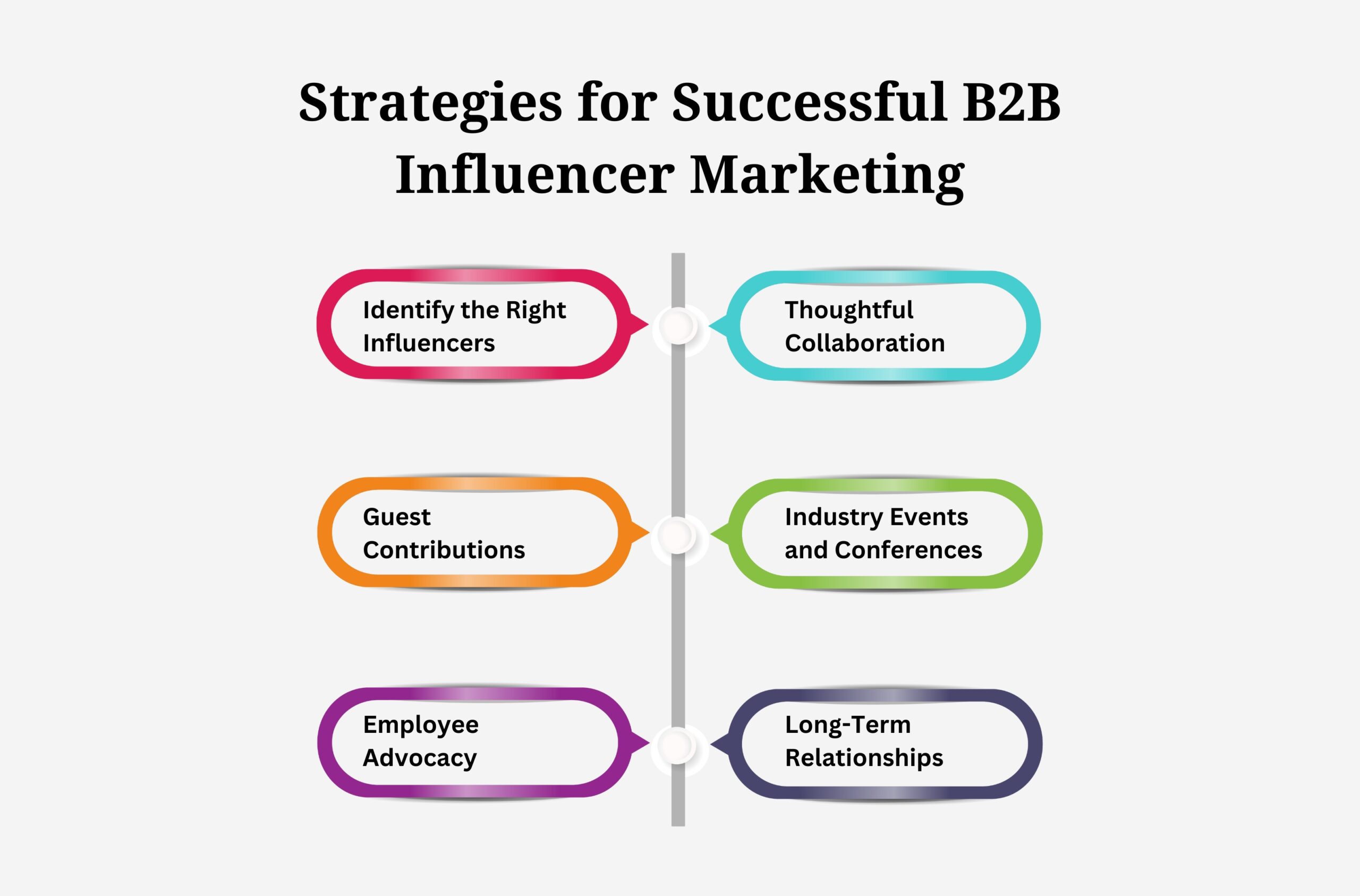
    Strategies for Successful B2B Influencer Campaigns

    1. Identify the Right Influencers: 

    Seek out influencers who are well-respected in your industry, have a strong online presence, and align with your brand’s values and objectives. Their credibility should complement your brand’s mission.

    2. Thoughtful Collaboration: 

    Collaborate with influencers on meaningful and insightful content that addresses industry challenges, trends, and solutions. This content should provide genuine value to your target audience.

    3. Educational Webinars and Workshops: 

    Host webinars or workshops in partnership with influencers to provide in-depth insights, training, and knowledge-sharing. This showcases your brand’s commitment to education and professional development.

    4. Guest Contributions: 

    Invite influencers to contribute guest blog posts, articles, or podcasts that provide unique perspectives on industry trends, fostering a collaborative exchange of insights.

    5. Industry Events and Conferences: 

    Partner with influencers to co-host or participate in industry events, panels, and conferences, showcasing your brand’s active engagement in thought leadership.

    6. Employee Advocacy: 

    Empower your employees to be influencers within their respective fields. Encourage them to share their expertise on social media and industry platforms, expanding your brand’s reach.

    7. Long-Term Relationships: 

    Cultivate long-term relationships with influencers to build trust and authenticity over time. A series of collaborations strengthen the influencer’s association with your brand.


    Case Study: B2B Influencer Marketing Example

    A leading B2B software company leverages influencer marketing to connect with professionals in the tech industry. They collaborated with industry experts and C-level executives to co-create thought-provoking whitepapers and webinars discussing emerging technology trends. By tapping into the influencers’ expertise and aligning their insights with the company’s offerings, the campaign garnered substantial engagement and positioned the brand as an authority within the tech landscape.


    Does B2B Influencer Marketing really Work?

    B2B influencer marketing can be effective, as it involves collaborating with industry experts and thought leaders to promote your products or services to their relevant audience. When executed well, it can enhance credibility, reach, and engagement within the B2B space. However, success depends on proper targeting, authenticity, and aligning influencer content with your brand’s values and goals.


    Conclusion

    B2B influencer marketing represents a strategic approach to nurturing relationships, fostering thought leadership, and building credibility within professional networks. By harnessing the influence and authority of industry experts, brands can engage in meaningful conversations, contribute valuable insights, and position themselves as trusted partners. 

    As the B2B landscape continues to evolve, influencer marketing emerges as a pivotal strategy to unlock new avenues for growth, authenticity, and engagement with the professional audiences that drive industries forward.


    Frequently Asked Questions (FAQs)

    [/vc_column_text][vc_toggle title=”How do I find the right B2B influencers?” css=””]Identifying the right influencers involves research within your industry. Look for individuals with expertise, a strong online presence, and a following that aligns with your target audience.[/vc_toggle][vc_toggle title=”How do I approach B2B influencers for collaboration?” css=””]Reach out with a personalized pitch that outlines the benefits of working together. Be clear about your goals, expectations, and how the collaboration can be mutually beneficial.[/vc_toggle][vc_toggle title=”How can I measure the ROI of my B2B influencer campaign?” css=””]Calculate ROI by comparing the cost of the campaign to the revenue generated through leads or conversions. Track the impact on brand awareness and long-term customer relationships.[/vc_toggle][vc_toggle title=”What are some successful examples of B2B influencer marketing campaigns?” css=””]Research case studies in your industry to find examples of effective B2B influencer marketing campaigns. Analyze their strategies and tactics to gain insights for your own efforts.[/vc_toggle][vc_toggle title=”What are the benefits of B2B influencer marketing?” css=””]Benefits include increased brand awareness, lead generation, thought leadership, and enhanced credibility within your industry. It can also foster long-term relationships with influencers.[/vc_toggle][/vc_column][/vc_row]

  • The Future of Content Consumption: Predictive Personalization

    [vc_row][vc_column][vc_column_text css=””]In digital content, the key to capturing and retaining audiences lies in “predictive personalization“. As technology advances and data analytics become more sophisticated, content consumption is undergoing a transformational shift toward predictive personalization. This paradigm shift is poised to revolutionize how individuals interact with content as it goes beyond mere customization to anticipate user preferences and needs.


    The Evolution of Predictive Personalization

    Personalized content has been a buzzword for some time, but it has traditionally relied on user-provided data and behavior patterns. With predictive personalization, a new era emerges – one where artificial intelligence and machine learning algorithms analyze vast amounts of data to anticipate user behavior before it happens. This anticipatory approach goes beyond reacting to user actions; it proactively tailors content to suit users’ tastes, interests, and even emotions.


    Understanding Predictive Personalization

    At the core of predictive personalization is data – big data, to be precise. By collecting, analyzing, and interpreting a user’s historical interactions with content, predictive algorithms can forecast what a user is likely to engage with in the future. This is achieved through a combination of machine learning techniques, including collaborative filtering, natural language processing, and sentiment analysis. The result is a highly curated content experience that caters to individual preferences.


    Anticipating User Needs

    One of the most fascinating aspects of predictive personalization is its ability to anticipate user needs. Imagine opening your favorite news app, and before you even search for a topic, relevant articles are already displayed based on your interests. Similarly, streaming platforms could queue up TV shows and movies aligned with your mood or past viewing habits. This anticipatory approach not only enhances user experience but also saves time and eliminates decision fatigue.


    Hyper-Relevant Recommendations

    Predictive personalization enables content creators to craft hyper-relevant recommendations that resonate with users on a deeper level. Brands can align their messaging with a user’s preferences, ensuring that the content is not only timely but also tailored to the user’s individual context. This level of relevance fosters a stronger connection between users and the content, leading to increased engagement and loyalty.


    Challenges and Considerations

    While the promise of predictive personalization is exciting, it comes with its own set of challenges and considerations. Privacy concerns remain at the forefront, as predictive algorithms rely heavily on user data. Striking the delicate balance between personalization and privacy is crucial to prevent overstepping ethical boundaries.

    Additionally, the potential for creating echo chambers – where users are only exposed to content that reinforces their existing beliefs – is a concern that must be addressed.


    The Role of AI and Machine Learning

    At the heart of predictive personalization lies artificial intelligence (AI) and machine learning (ML). These technologies power the algorithms that analyze data patterns, predict user behavior, and offer tailored recommendations. As AI and ML continue to evolve, their applications in predictive personalization will become even more refined, enhancing the accuracy of content predictions and ensuring a seamless user experience.


    Personalization in Various Industries

    Predictive personalization isn’t limited to a signal industry – it has the potential to transform various sectors. In e-commerce, for instance, online retailers can provide personalized product recommendations that align with a shopper’s preferences and browsing history.

    In education, learning platforms can predict which topics a student may struggle with and offer targeted resources in advance. Even healthcare could benefit, with predictive algorithms helping doctors anticipate patient needs and recommend treatments.


    The Future of Content Consumption

    The future of content consumption is undeniably tied to predictive personalization. As technology continues to evolve, we can expect more immersive and intuitive content experiences. However, this transformation will require a collective effort from content creators, technology developers, and policymakers to address challenges related to privacy, bias, and user autonomy. By navigating these challenges responsibly, the potential for predictive personalization to reshape content consumption is immense.


    Predictive Personalization

    Conclusion

    Predictive personalization represents a shift from reactive customization to proactive content curation. Through the power of AI and machine learning, content consumption is poised to become a more immersive, relevant, and engaging experience. 

    While challenges remain, the benefits of anticipatory content delivery are too significant to ignore. As we step into the future, content creators and consumers alike have the opportunity to embrace this new era and shape the landscape of predictive personalization for the better.


    Frequently Asked Questions (FAQs)

    [/vc_column_text][/vc_column][/vc_row][vc_row][vc_column][vc_toggle title=”What is content consumption?” css=””]Content consumption refers to the act of consuming or engaging with various types of digital or multimedia content, such as articles, videos, music, podcasts, and more, through various digital devices and platforms.[/vc_toggle][vc_toggle title=”What is personalized content consumption?” css=””]Personalized content consumption involves tailoring content recommendations and experiences to an individual’s preferences and behavior. This is often done using algorithms and AI to provide content that is most relevant to a specific user.[/vc_toggle][vc_toggle title=”How can I consume content responsibly?” css=””]Responsible content consumption involves being mindful of data usage, supporting sustainable practices, and being critical of the information you consume. It’s also important to respect copyright and intellectual property rights when engaging with digital content.[/vc_toggle][vc_toggle title=”What is the future of content consumption?” css=””]The future of content consumption includes trends like AI-driven personalization, AR and VR integration, interactive content, blockchain-based ownership, sustainability efforts, and globalized content experiences.[/vc_toggle][vc_toggle title=”How can I ensure responsible content consumption?” css=””]Responsible content consumption involves being mindful of the content you engage with. This includes fact-checking information, avoiding excessive screen time, and supporting ethical content creators. Additionally, consider the environmental impact of data consumption and strive for sustainable practices.[/vc_toggle][/vc_column][/vc_row]

  • Know the Best Effective Social Media Marketing Strategy

    Social Media Marketing has turned out to be an indispensable part of contemporary business technique. With billions of users worldwide, platforms like Facebook, Instagram, Twitter, and LinkedIn offer unparalleled opportunities for businesses to reach their target audience and promote their products or services. 

    However, effective social media marketing requires careful planning and execution. In this article, we will discuss some proven strategies that can help businesses make the most of their social media marketing efforts.

    • Set Clear Goals For Social Media Plan: 

    Before diving into social media marketing, it is crucial to establish clear and measurable goals. Whether it’s increasing brand awareness, driving website traffic, generating leads, or boosting sales, having well-defined objectives will guide your strategy and allow you to track your progress effectively.

    • Identify your target audience: 

    Understanding your target audience is essential for successful social media marketing. Conduct marketplace research to become aware of the demographics, pastimes, and choices of your ability clients. This information will help you tailor your content and messaging to resonate with your audience and drive engagement.

    • Choose the Right Social Media Platforms: 

    Not all social media platforms are suitable for every business. Determine which platforms your target audience uses most frequently and focus your efforts there. For instance, if you are targeting professionals, LinkedIn might be more effective than Instagram. By concentrating your resources on the platforms that matter most to your audience, you can maximize your reach and engagement.

    • Create Compelling Content: 

    Content is the cornerstone of social media marketing. Expand a content material method that aligns with your emblem identity and resonates with your target market. Create a mix of different content types, including images, videos, infographics, blog posts, and user-generated content. Ensure that your content is valuable, informative, entertaining, and shareable to encourage engagement and viral sharing.

    • Utilize Visuals Content On Social Media: 

    Visual content tends to perform exceptionally well on social media platforms. Incorporate high-quality images, videos, and graphics into your social media posts to grab attention and convey your message effectively. Use professional photography, eye-catching designs, and engaging videos to captivate your audience and increase their likelihood of sharing your content.

    • Message and Consistent Content Updates: 


    Consistency is key when it comes to social media marketing. Establish a consistent brand voice, visual style, and posting schedule across all your social media platforms. Consistency helps build brand recognition, establishes trust with your audience, and encourages them to engage with your content regularly.

    • Have interaction with your target market


    Social media is a – way conversation channel. Encourage your audience to interact with your content by posing questions, asking for feedback, and responding to comments and messages promptly. Engaging with your audience builds a sense of community and strengthens customer relationships, leading to increased brand loyalty and advocacy.

    • Leverage Influencer Marketing: 

    Influencer marketing can be a powerful tool to expand your reach and tap into new audiences. Perceive influencers on your niche who have a widespread following and align with your emblem values. Collaborate with influencers to create sponsored content or run giveaways to leverage their influence and reach a wider audience.

    • Utilize Paid Advertising: 


    While organic reach is valuable, paid advertising on social media platforms can provide an extra boost to your marketing efforts. Platforms like Facebook, Instagram, and LinkedIn offer robust targeting options to allow you to reach specific demographics, interests, and behaviors. Allocate a portion of your marketing budget to run targeted ads and monitor their performance to optimize your campaigns.

    • Track and Analyze Social Media Results: 


    Regularly track and analyze the performance of your social media marketing efforts. Utilize platform analytics and third-party tools to measure key metrics such as reach engagement, click-through rates, conversions, and return on investments (ROI). Use these insights to refine your strategy, identify what works best for your audience, and make data-driven decisions.

    • Complete and optimize your Social Media profiles: 


    Start by ensuring that your social media profiles are fully completed with accurate and up-to-date information. Use consistent branding elements such as profile pictures, cover photos, and descriptions across all platforms. Optimize your profiles by incorporating relevant keywords and hashtags to improve discoverability.

    • Optimize Content for Each Platform: 

    Predictive PersonalizationEach social media platform has its unique features and best practices. Tailor your content to fit the specific requirements of each platform. For example, on Instagram, focus on visual content with captivating images and concise captions. On LinkedIn, share industry insights thought leadership articles, and professional networking opportunities. Adapting your content to each platform will enhance its effectiveness and appeal to the respective audience.

    • Utilize Hashtags on Social Media Platforms : 

    Hashtags are powerful tools for increasing the visibility of your content and reaching a broader audience. Research and use relevant hashtags that are popular in your industry or niche. Incorporate both trending and niche-specific hashtags in your posts to increase the likelihood of being discovered by users who are interested in your content.

    • Encourage Social Sharing: 

    Make it easy for your audience to share your content by incorporating social sharing buttons on your website and blog. Include calls to action in your social media posts to encourage users to like, comment, share, and tag their friends. User-generated content, contests, and giveaways are also effective ways to encourage social sharing and increase brand exposure

    • Stay Updated and Experiment: 


    Social media platforms are constantly evolving, with new features and trends emerging regularly. Stay updated with the latest developments and experiment with new features and strategies. 


    Social Media Marketing Frequently Asked Questions (FAQs)

    Is paid advertising necessary for Social Media Optimization ?

    While organic efforts are important, paid advertising can boost your reach and target specific audiences. It’s often a valuable part of an SMO strategy.


    1. What are the common mistakes to avoid in Social  Media Marketing?

    Avoid over posting, neglecting customer interactions, using irrelevant hashtags, and not monitoring your analytics. Also, be careful with automation, as it can come across as impersonal.


    1. How can I stay updates with SMO best practices?

    Stay informed by following industry blogs, attending webinars, and experimenting with new strategies. Social media trends can change rapidly, so ongoing learning is essential.


    1. Why is Social Media Marketing is important for businesses?

    SMO helps businesses build a strong online presence, connect with their target audience, drive traffic to their websites, and ultimately, increase conversions and sales.